Shree Krishna Janmashtami: Complete Guide
2026-02-16
17.4 min read
Krishna Janmashtami celebrates the birth of Lord Krishna, one of Hinduism's most beloved deities and the eighth avatar of Lord Vishnu. This guide covers the historical and scriptural background, the deeper significance of Krishna's birth, regional traditions, and why this celebration remains vibrant for millions of devotees worldwide, especially diaspora Hindus maintaining a devotional connection across distance.
Who is Lord Krishna?
Lord Krishna is perhaps the most complete divine personality in Hindu tradition, simultaneously warrior, statesman, philosopher, lover, friend, child, and supreme deity.
The Eighth Avatar: According to the Bhagavata Purana and other texts, Krishna is the eighth incarnation of Lord Vishnu, who descends to earth whenever dharma declines and adharma rises.
The Complete Manifestation: Unlike other avatars who manifested specific divine qualities, Krishna is considered "Purna Avatar", the complete, full manifestation of the divine in human form.
Multiple Aspects:
-
Bal Gopal - The mischievous, butter-stealing child
-
Murlidhar - The enchanting flute player
-
Govinda - The cowherd and protector of cows
-
Parthasarathi - Arjuna's charioteer and teacher
-
Dwarkadheesh - The king of Dwaraka
-
Radha Vallabh - Radha's beloved
-
Yogeshwara - The lord of yoga
Historical Context: Krishna lived approximately 5,000 years ago (according to traditional calculations) during the Dwapara Yuga, in the region of Mathura-Vrindavan in present-day Uttar Pradesh, India.
The Story of Krishna's Birth
Understanding Janmashtami requires knowing the dramatic circumstances of Krishna's birth:
The Background
Mathura's Tyrant King: Kansa, the cruel king of Mathura, had usurped the throne from his father and ruled through fear and oppression.
The Prophecy: During his sister Devaki's wedding to Vasudeva, a divine voice announced that Devaki's eighth son would kill Kansa.
Imprisonment: Terrified, Kansa imprisoned his sister and her husband, killing each of their newborn children to prevent the prophecy.
Divine Plan: The seventh and eighth children would be special, Balarama and Krishna, avatars of Shesha (the cosmic serpent) and Vishnu himself.
The Birth Night
Ashtami Tithi: On the eighth day of the dark fortnight in Bhadrapada month, during a stormy midnight, Lord Vishnu incarnated as baby Krishna in the prison cell.
Miraculous Events:
-
The chains binding Vasudeva fell away
-
Prison guards fell into a deep sleep
-
Heavy rain and storm began
-
The Yamuna River parted to let Vasudeva cross
The Transfer: Vasudeva carried the newborn Krishna across the flooded Yamuna to Gokul, where he was exchanged with the baby daughter of Yashoda and Nanda, who would become Krishna's foster parents.
Shesha's Protection: During the journey, the thousand-headed serpent Shesha protected baby Krishna from the rain with his hood.
Kansa's Deception: When Kansa tried to kill the baby girl (thinking she was the eighth child), she transformed into Goddess Durga and prophesied that his killer was already safe elsewhere.
Childhood in Gokul
Krishna grew up in Gokul/Vrindavan among cowherds:
-
Performed miraculous acts even as an infant
-
Defeated demons sent by Kansa
-
Enchanted everyone with his beauty and flute playing
-
Displayed his divine nature multiple times
-
Eventually returned to Mathura to fulfil the prophecy
Scriptural Foundations of Janmashtami
Bhagavata Purana
The most detailed account of Krishna's birth appears in the 10th Canto (Skanda) of the Bhagavata Purana (also called Srimad Bhagavatam), composed by Sage Vyasa.
Birth Description: The text describes Devaki's vision of the four-armed Vishnu form before Krishna assumed the form of an infant. This establishes his divine nature from the moment of birth.
Philosophical Significance: The Bhagavatam emphasises that Krishna's birth was not an ordinary biological birth but a divine "appearance" (avatara) in the material world.
Mahabharata
While Krishna's childhood isn't the Mahabharata's focus, it establishes his role in the cosmic drama and his divine mission to restore dharma.
Harivamsa
This supplement to the Mahabharata provides additional details about Krishna's life, including Janmashtami-related events.
Vishnu Purana
Contains another version of Krishna's birth and childhood, emphasising his role as Vishnu's avatar.
Bhagavad Gita
Though not about his birth, the Gita (Chapter 4, verses 7-8) contains Krishna's own explanation of why avatars descend:
"Whenever there is a decline of dharma and rise of adharma, O Bharata, then I manifest Myself. For the protection of the good, destruction of evil-doers, and establishment of dharma, I am born age after age."
This provides the philosophical foundation for celebrating divine births like Janmashtami.
Deeper Significance of Krishna's Birth
Theological Meaning
Divine Descending to Human Level: Krishna's birth demonstrates that the infinite divine can take a finite human form without losing its divine nature.
Accessibility of God: By appearing as a helpless baby, God makes himself utterly accessible, removing the fear and distance that humans feel toward the transcendent.
Playful Divine Nature: Krishna's mischievous childhood (butter-stealing, breaking pots) shows that the divine is not only severe but also playful and joyful.
Bhakti Path Validation: Krishna's relationships with parents, friends, gopas and gopis (cowherds) validate devotion (bhakti) as a legitimate spiritual path alongside knowledge and action.
Symbolic Interpretation
Birth in Prison: Symbolises the soul trapped in material existence (represented by Devaki and Vasudeva in chains).
Midnight Birth: Darkness of midnight represents spiritual ignorance; Krishna's birth represents the light of consciousness/knowledge appearing.
Mathura to Gokul Journey: Moving from prison (bondage) to Gokul (go=senses, kul=control) symbolises a spiritual journey from bondage to liberation.
Rain and Storm: Material difficulties and obstacles of life through which the divine protects us (Shesha's hood).
The Exchange: The false ego (represented by the goddess/maya) protects the true self (baby Krishna) until ready for revelation.
Devotional Significance
Personal Relationship: Baby Krishna invites maternal, protective devotion, the gentlest form of bhakti that even sceptics can feel.
Surrender and Trust: Devaki and Vasudeva's situation teaches complete surrender even in impossible circumstances.
Divine Protection: The miraculous events assure devotees that divine grace operates beyond ordinary causation.
Victory Over Evil: Krishna's eventual defeat of Kansa gives hope that good ultimately triumphs, despite apparent domination by evil.
Regional Janmashtami Traditions
Mathura-Vrindavan (Uttar Pradesh)
The Epicentre: As Krishna's birthplace and childhood home, Mathura-Vrindavan sees the most elaborate celebrations.
Key Features:
-
Week-long celebrations (Janmashtami Mela)
-
Krishna Janmabhoomi temple becomes a pilgrimage centre
-
Ras Leelas (theatrical performances of Krishna's pastimes)
-
Elaborate decorations of temples
-
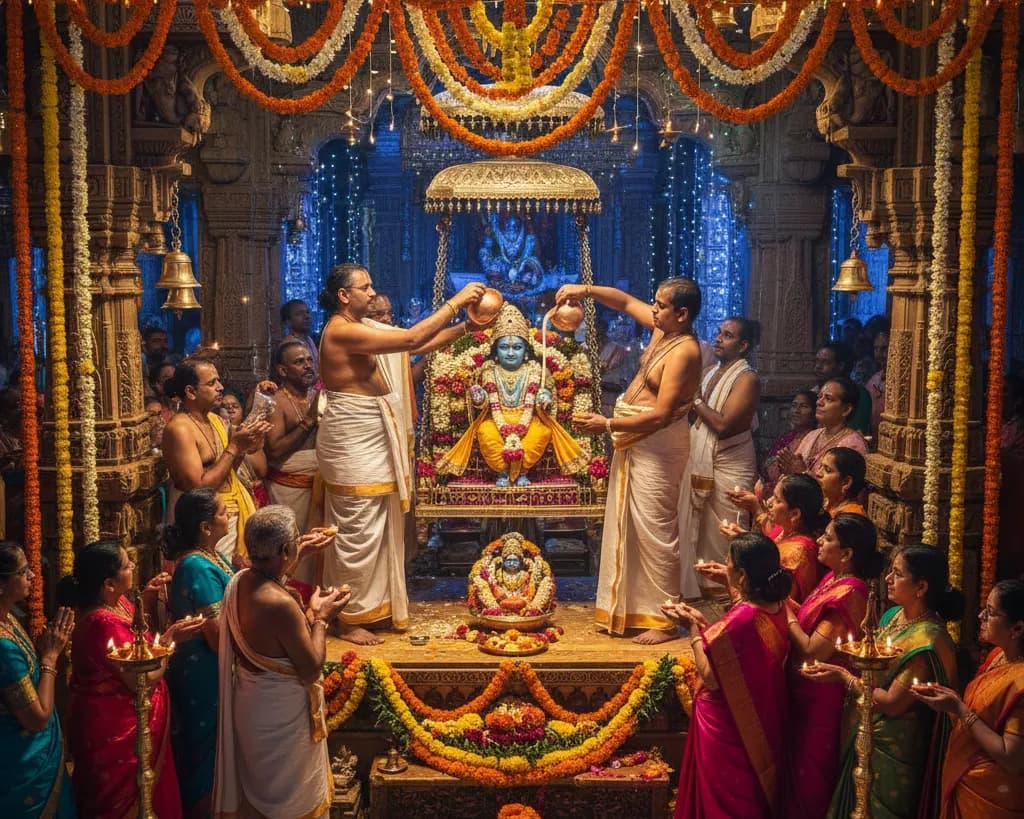
Midnight abhishekam at all major temples
-
Thousands of pilgrims are visiting
Vrindavan Specifics:
-
Banke Bihari temple celebrations
-
Radha Raman temple festivities
-
ISKCON Vrindavan's international celebration
-
Yamuna aarti
Maharashtra (Dahi Handi)
Unique Tradition: The "Dahi Handi" (curd pot) breaking competition commemorates Krishna stealing butter.
The Practice:
-
Clay pots filled with curd, money, etc., hung high
-
Teams (Govinda Pathak) form human pyramids
-
Climb to break the pot
-
Competitive, festive atmosphere
-
Particularly famous in Mumbai
Significance: Celebrates Krishna's playful nature and encourages teamwork, courage, and determination.
Gujarat
Dwarkadheesh Connection: Special significance as Krishna later ruled from Dwaraka in Gujarat.
Traditions:
-
Elaborate makhan handi ceremonies
-
Community kirtan gatherings
-
All-night bhajan sessions
-
Fasting and feasting
-
Dahi-handi in some areas
South India (Tamil Nadu, Karnataka, Kerala, Andhra Pradesh)
Gokulashtami: Often called Gokulashtami in the south.
Traditions:
-
Drawing baby footprints (Krishna's feet) from the entrance to the puja room with rice flour
-
Elaborate kolam (rangoli) designs
-
Uriyadi (pot-breaking) is similar to Dahi Handi
-
Special offerings like seedai, murukku, aval
-
Naming babies born on this day as Krishnan/Krishna
-
Gokulastami Rathotsavam (chariot procession) in some temples
Bengal and Odisha
Sri Krishna Janmashtami: Strong Vaishnava tradition due to Chaitanya Mahaprabhu's influence.
Features:
-
Emphasis on sankirtan (congregational chanting)
-
Offerings of special sweets
-
Jhulana (swing) decoration for baby Krishna
-
Temple celebrations
-
Prabhu Jagannath's connection in Odisha
Nepal
Cultural Integration: Krishna worship is well-established in Nepal, particularly in Kathmandu Valley.
Nepali Janmashtami:
-
Krishna Mandir (Patan) becomes a major celebration centre
-
Traditional bhajans in Newari and Nepali
-
Community gatherings and feasting
-
Fasting observed widely
-
Integration with local devotional customs
ISKCON Tradition (Global)
International Spread: ISKCON (International Society for Krishna Consciousness) has globalised the Janmashtami celebration.
Features:
-
Strict adherence to Prabhupada's guidelines
-
Elaborate Abhishekam with eight offerings
-
Theatrical productions (Krishna leelas)
-
Prasadam feast for hundreds/thousands
-
24-hour kirtan in some centres
-
Tulsi puja integration
-
Philosophical classes on Krishna consciousness
The Midnight Timing: Why It Matters
Scriptural Timing
Ashtami Tithi: Krishna was born on the Rohini Nakshatra during Ashtami (eighth day) of Krishna Paksha (dark fortnight) in Bhadrapada month.
Midnight Hour: Traditional texts specify that Krishna appeared at midnight (Nishitha Kala).
Astrological Significance
Planetary Configuration: Ancient texts describe specific planetary positions at Krishna's birth moment, considered highly auspicious.
Rohini Nakshatra: The lunar mansion Rohini (presided by Brahma) is considered the most auspicious nakshatra, associated with beauty, growth, and abundance.
Midnight Timing:
-
Represents the darkest hour symbolically (spiritual ignorance)
-
The transition point between days
-
Brahma muhurta proximity (most spiritually potent time)
-
Maximum spiritual receptivity
Practical Observance
Modern Calculation: Exact midnight timing varies slightly by location and year based on precise astrological calculations.
Temple Practices: Most temples perform abhishekam exactly at midnight or during the most auspicious window within midnight hours.
Home Observance: Families try to stay awake until midnight for puja, though some perform at a convenient evening hour, with devotional intent mattering most.
The Fasting Tradition (Vrata)
Types of Fasts
Nirjala (Waterless): Complete fast without even water from sunrise to midnight. Most austere and traditional.
Phalahar (Fruit Fast): Consuming only fruits, milk, and fruit-based items. Commonly practised when a complete fast is difficult.
Sabudana/Singada Fast: Specific Vrata-appropriate foods like sago, water chestnut flour, potatoes, and certain nuts.
Ekadashi-Style: Avoiding grains and beans but consuming dairy, fruits, and certain vegetables.
Symbolic: Some, due to health conditions, observe the spirit of fasting through sattvic vegetarian food and spiritual discipline, even if not technically fasting.
Purpose of Fasting
Purification: Physical fasting aids in mental purification and spiritual receptivity.
Discipline: Demonstrates devotion through self-control and sacrifice.
Empathy: Experiencing hunger creates empathy for Krishna's early life struggles and for the poor.
Spiritual Focus: Reduces the physical body's demands, allowing more mental energy for spiritual practices.
Tradition: Following ancient practices connects devotees across generations and geography.
Breaking the Fast
Timing: Traditionally, after midnight puja and partaking of Krishna prasad.
First Food:
-
Water first (sometimes from the Tulsi plant)
-
Light fruits
-
Krishna's favourites: butter, mishri, milk
-
Gradually heavier foods
-
A full meal is usually the morning after
Prasad Importance: First food after fast should be prasad (sanctified offering), carrying Krishna's blessings.
Janmashtami for Children
Age-Appropriate Engagement
Toddlers (1-3):
-
Dressing as Krishna/Radha with peacock feathers and yellow clothes
-
Simple storytelling with pictures
-
Playing with toy cows, flute
-
Singing simple "Hare Krishna" or lullabies
Young Children (4-8):
-
Learning butter-stealing stories
-
Simple bhajan singing
-
Helping with decoration
-
Understanding Krishna as a baby and friend
-
Drawing/colouring Krishna pictures
-
Breaking small dahi handi
Older Children (9-13):
-
Deeper stories from Krishna's life
-
Understanding the Bhagavad Gita basics
-
Participation in bhajan/kirtan
-
Helping prepare offerings
-
Learning about the avatara concept
-
Fasting participation (modified version)
Teenagers:
-
Philosophical discussions on Krishna's teachings
-
Reading the Bhagavad Gita portions
-
Full participation in fasting and ceremonies
-
Leadership in family observance
-
Understanding Krishna consciousness in the modern context
Educational Value
Moral Development: Krishna stories teach courage, friendship, dharma, protecting the weak, and fighting injustice.
Cultural Identity: Especially for diaspora children, Janmashtami provides strong cultural anchoring.
Devotional Foundation: Early positive association with Krishna creates a lifelong devotional tendency.
Family Bonding: Preparing together, fasting together, and celebrating together strengthen family unity.
Modern Relevance of Krishna's Message
Universal Themes
Divine Accessibility: Krishna's human form shows the divine is not distant but intimately present in life.
Ethics in Action: The Bhagavad Gita's teaching of karma yoga, acting righteously without attachment to results, remains relevant for modern professional life.
Multiple Paths: Krishna validates different spiritual paths (bhakti, jnana, karma), showing religious pluralism within Hindu tradition.
Inner Divinity: "I am seated in the hearts of all beings", a message that the divine dwells within, not just in temples.
Playfulness and Joy: Antidote to overly serious, guilt-based religiosity, spirituality can be joyful, playful, celebratory.
For Diaspora Hindus
Cultural Preservation: Janmashtami becomes an annual touchstone for maintaining cultural and spiritual connections.
Community Building: Temple Janmashtami celebrations create Hindu community bonds in foreign lands.
Interfaith Bridge: Krishna's universal appeal (like Jesus, Buddha) helps explain Hinduism to non-Hindu friends.
Spiritual Practice: Annual fasting and devotion provide structured spiritual discipline even in a secular environment.
Children's Education: Immersive cultural experience that can't be replicated through occasional temple visits or YouTube videos.
Philosophical Depth: Krishna in Hindu Thought
Vedanta Perspective
Krishna is Brahman, the ultimate reality that takes form to guide humanity while remaining unchanged in essence.
Yoga Philosophy
Krishna embodies all yogas:
-
Bhakti Yoga - Devotional love
-
Karma Yoga - Selfless action
-
Jnana Yoga - Wisdom and knowledge
-
Raja Yoga - Meditation and self-control
Vaishnava Theology
In Vaishnavism, Krishna is not just Vishnu's avatar but the original supreme personality from whom Vishnu emanates, the source rather than manifestation.
Janmashtami and Bhagavad Gita Connection
While Janmashtami celebrates Krishna's physical birth, it also honours the birth of his teachings:
The Battlefield Teaching: The Bhagavad Gita, spoken on the Kurukshetra battlefield, contains Krishna's most systematic philosophy.
Reading Tradition: Many devotees read or recite portions of the Gita on Janmashtami as part of the observance.
Core Messages Relevant to Birth Celebration:
-
Avatar descends to restore dharma (Chapter 4)
-
The eternal soul never dies, only changes bodies (Chapter 2)
-
Seeing God in all beings (Chapter 6)
-
Devotion as supreme path (Chapter 12)
Comparison with Other Avatar Celebrations
Rama Navami: Celebrates Lord Rama's birth. More focused on ideal kingship and dharma exemplar.
Buddha Purnima: Buddha's birth. Emphasis on enlightenment and compassion.
Janmashtami's Uniqueness: Combines multiple aspects of baby god, divine lover, warrior, teacher, statesman, friend, making it the most complete deity celebration.
Krishna Janmashtami is far more than a birthday party for a mythological figure. It's an annual opportunity to reconnect with core Hindu philosophical and devotional themes through the accessible, beloved personality of Krishna, the child, friend, lover, teacher, and supreme deity all in one.
For NRNs and diaspora Hindus, Janmashtami serves as a cultural anchor, spiritual renewal opportunity, and means of transmitting profound traditions to the next generation. Whether celebrated through midnight temple visits, elaborate home ceremonies, or online puja services connecting to homeland traditions, the essence remains the same devotion to and celebration of Krishna's divine presence in the world.
The ancient story of a divine child born in prison, destined to defeat evil and teach enlightenment, continues to inspire millions, reminding them that the divine is not distant but intimately present, not severe but playful, not exclusive but accessible to all who approach with love.
Social Share: