Shraddha Karma: Complete Guide to Hindu Ancestral Rites
2026-02-16
20.2 min read
Shraddha is one of Hinduism's most ancient and significant rituals, a sacred duty to honour deceased ancestors and provide for their spiritual welfare. This comprehensive guide covers the scriptural foundations, deep philosophical significance, different types of shraddha, Pitru Paksha observances, and why this practice remains vital for modern Hindu families, especially those navigating tradition across distance and cultural contexts.
What is Shraddha?
Etymology and Meaning
The word "Shraddha" (श्राद्ध) comes from two Sanskrit roots:
-
Shrat (श्रत्) - meaning truth, reverence
-
Dha (धा) - meaning to give, to place
Combined, Shraddha means "given with faith and reverence" or "offering made with devotion and sincerity."
Philosophical Foundation
Shraddha is based on several interconnected Hindu philosophical concepts:
Pitru Rin (Ancestral Debt): Hindu philosophy identifies three primary debts (rin) every person inherits:
-
Deva Rin - debt to gods (repaid through worship)
-
Rishi Rin - debt to sages (repaid through learning)
-
Pitru Rin - debt to ancestors (repaid through shraddha and progeny)
Parents gave you life, nurtured you, and created conditions for your existence. This creates a spiritual obligation to honour them after death and care for their souls.
Doctrine of Karma and Rebirth: Souls undergo cycles of birth and death based on karma. Proper shraddha assists the departed soul in:
-
Working through remaining karma
-
Achieving better rebirth
-
Progressing toward moksha (liberation)
-
Avoiding entrapment in intermediate realms
Interconnected Existence: The Hindu worldview sees the living and dead as interconnected. Living descendants can positively influence ancestors' spiritual state through shraddha, just as ancestors can influence descendants' welfare through blessings or afflictions.
Scriptural Foundations
Vedic References
Rigveda: Contains hymns invoking Pitrs (ancestors) and describing offerings for their welfare. The concept of three generations of ancestors appears here.
Yajurveda: Describes specific procedures for ancestral offerings and the sacred kusha grass used in pitru rituals.
Atharvaveda: Contains protective mantras and verses specifically for departed souls and ancestor worship.
Post-Vedic Texts
Brihadaranyaka Upanishad: Discusses the path of ancestors (pitriyana) and souls' journey after death.
Grihya Sutras:
-
Ashvalayana, Paraskara, and Gobhila Grihya Sutras contain detailed shraddha procedures.
-
Specify timing, offerings, mantras, and ritual sequence
-
Establish a foundation for modern shraddha practice
Dharma Shastras:
Manu Smriti: Extensive section on shraddha, proper timing, who should perform, what offerings, and consequences of neglect.
Yajnavalkya Smriti: Details different types of shraddha and their purposes.
Parasara Smriti: Discusses Pitru Paksha specifically and daily shraddha obligations.
Puranic References
Garuda Purana: Perhaps the most comprehensive text on death rites and shraddha. Describes:
-
Soul's journey after death
-
Importance of shraddha at various stages
-
Consequences of neglecting ancestral rites
-
Detailed procedures for different shraddha types
Vishnu Purana: Describes the origin of shraddha and its cosmic significance.
Matsya Purana: Contains details about Pitru Paksha and its importance.
Brahma Vaivarta Purana: Discusses the benefits of shraddha and pitru worship.
Bhagavad Gita Reference
While not focused on shraddha, the Gita acknowledges ancestral worship as part of prescribed duties (Krishna mentions offerings to Pitrs in Chapter 9).
The Three Generations of Ancestors
Hindu tradition specifically honours three recent generations:
First Generation (Father, Mother): Most important. Their shraddha is a primary obligation for children.
Second Generation (Grandparents - paternal and maternal): Four grandparents honoured in shraddha.
Third Generation (Great-grandparents): Eight great-grandparents complete the triad of three generations.
Beyond Three Generations: Earlier ancestors merge into the collective "ancient Pitrs" honoured during Pitru Paksha, but not individually.
Why Three Generations:
-
Living memory extends 3 generations typically
-
Spiritual connection is strongest within this range
-
Manageable scope for regular practice
-
Scriptural prescription
Understanding the Soul's Journey After Death
To understand Shraddha's purpose, one must understand the Hindu conception of death and the afterlife:
Immediate Post-Death Period
Preta Stage: For the initial period (traditionally up to one year), the deceased exists as "preta", a transitional state before becoming a Pitri (ancestor).
Vulnerability: The Preta stage is considered vulnerable. Soul hasn't fully detached from earthly existence or reached the next realm.
Special Rites: Specific "preta shraddha" ceremonies during the first year help the soul transition from preta to pitri status.
The Pitriyana (Path of Ancestors)
Pitriloka: Realm where satisfied ancestors dwell. Not a permanent heaven but an intermediate station on the soul's journey.
Duration: Souls remain in Pitriloka for varying periods based on karma and shraddha received from descendants.
Onward Journey: From Pitriloka, souls eventually:
-
Achieve moksha (liberation) if sufficiently evolved
-
Take a favourable rebirth if karma requires
-
Progress spiritually aided by descendants' shraddha
How Shraddha Helps
Spiritual Nourishment: Offerings provide subtle energy/sustenance for ancestors in their realm.
Karmic Alleviation: Prayers and rituals help burn remaining karma, easing the soul's burden.
Liberation Aid: Assists the soul in achieving freedom from the rebirth cycle.
Prevents Entrapment: Proper shraddha prevents souls from becoming trapped in lower realms or as wandering spirits.
Types of Shraddha
Based on Timing
Nitya Shraddha (Regular): Performed on specific recurring occasions, death anniversaries, amavasya, Pitru Paksha.
Naimittika Shraddha (Occasional): For special occasions, before marriage, childbirth, starting a business, etc.
Kamya Shraddha (Desire-driven): Performed seeking specific boons from ancestors, wealth, children, and success.
Vriddhi Shraddha (Celebratory): During auspicious occasions like weddings or childbirth, inviting ancestors' blessings for a happy event.
Parvana Shraddha: Routine annual or monthly shraddha for the deceased.
Sapindikarana: Ritual performed approximately one year after death, transforming preta into pitri.
Ekodishta Shraddha: For a single deceased person, typically during the first year.
Preta Shraddha: Series of shraddhas during the first year at specific intervals.
Based on Purpose
Tripindi Shraddha: Special comprehensive ritual covering three generations when regular shraddhas were missed. Also performed for unnatural deaths.
Narayan Bali: Elaborate ritual for appeasing troubled or wandering souls, particularly those who died violently or unnaturally.
Gaya Shraddha: Performed at Gaya (Bihar, India), considered especially powerful for ancestral liberation.
Mahalaya Shraddha: On Mahalaya Amavasya (the final day of Pitru Paksha), it covers all ancestors collectively.
Pitru Paksha: The Sacred Fortnight
What It Is
Timing: 15 days of Krishna Paksha (waning moon) in Bhadrapada/Ashwin month (typically September-October).
Also Called:
-
Mahalaya Paksha
-
Shraddha Paksha
-
Apara Paksha
-
Kanagat
Significance: Most auspicious period for ancestral rites. Traditional belief holds that during these 15 days:
-
Gates between worlds open
-
Ancestors descend to the earthly realm
-
They can more easily receive offerings
-
Shraddha performed has a multiplied effect
Daily Structure
Each of 15 days corresponds to a specific tithi (lunar day):
Day 1: Pratipada - shraddha for those who died on Pratipada tithi Day 2: Dwitiya - for those who died on Dwitiya tithi ...and so on through all 15 tithis.
The System: Perform shraddha on the Pitru Paksha day corresponding to the tithi on which your ancestor died.
Example: If the father died on Panchami (5th tithi), perform his shraddha on Panchami of Pitru Paksha.
Mahalaya Amavasya
Final Day: The 15th day, new moon (Amavasya), called Mahalaya or Sarvapitri Amavasya.
Universal Shraddha: Shraddha performed this day covers:
-
All ancestors whose individual tithis were missed
-
Unknown ancestors
-
Those who died on Amavasya itself
-
Relatives with no one to perform the shraddha
-
Collectively addressing the entire ancestral lineage
Most Important Day: For those who can't perform 15 daily shraddhas, performing on Mahalaya Amavasya alone is considered sufficient.
Restrictions During Pitru Paksha
Traditional Observances:
-
Avoid new ventures or purchases
-
No celebrations, festivals, weddings
-
Minimising social events
-
Vegetarian diet
-
Focus on ancestors and spirituality
-
Some observe partial fasting
Modern Adaptation: Many NRNs maintain regular life but set aside time for ancestral remembrance and shraddha observance.
The Shraddha Ritual Components
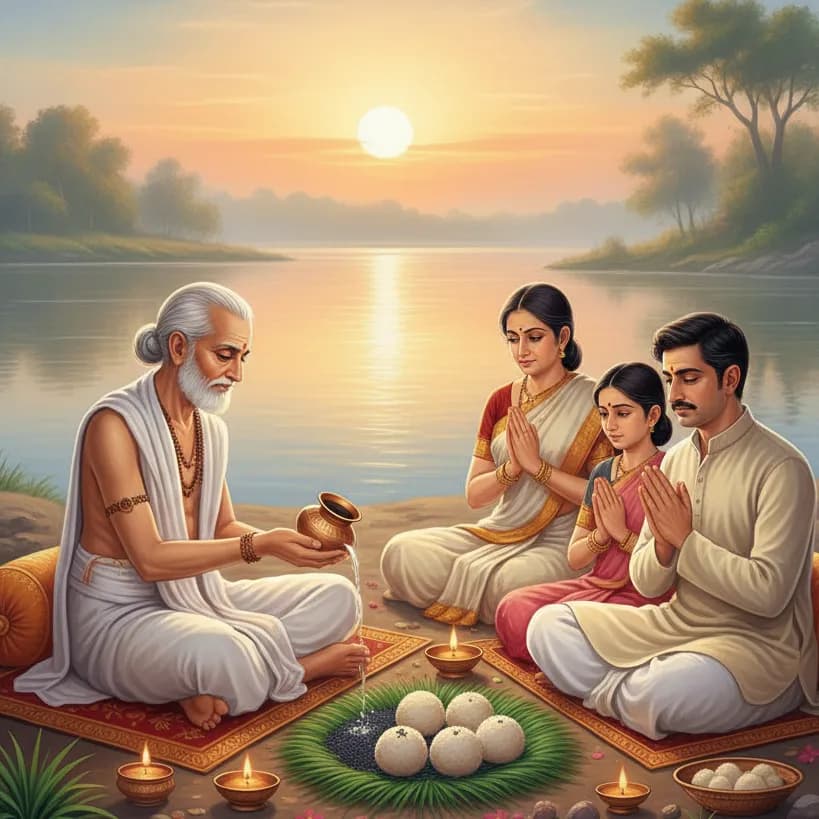
Pinda Dana (Rice Ball Offering)
What It Is: Sacred rice balls (pinda) offered to ancestors as spiritual food.
Composition:
-
Cooked rice
-
Barley
-
Black sesame seeds
-
Ghee
-
Milk
-
Sometimes herbs
Number: Typically three pindas representing three generations of ancestors.
Symbolism: The rice ball represents the subtle body (sukshma sharira) of the deceased. Offering pinda symbolically provides sustenance for their subtle existence.
Procedure: Pindas are placed on kusha grass with specific mantras invoking each ancestor by name while offering their respective pinda.
Disposal: After the ceremony, pindas are traditionally:
-
Immersed in a sacred river
-
Given to cows
-
Left for birds/animals
-
Buried in the earth (Different traditions vary)
Tarpan (Water Oblation)
What It Is: Offering water mixed with black sesame seeds (til) to ancestors.
Technique: Water cupped in hands, sesame seeds added, ancestor's name recited, water poured out while facing a specific direction (usually south, direction of Yama, lord of death).
Mantras: Specific mantras for father, grandfather, and great-grandfather are repeated for each side (paternal and maternal).
Materials:
-
Water (preferably from a sacred river or a pure source)
-
Black sesame seeds (til)
-
Kusha grass
-
Sometimes flowers, sandalwood
Significance: Water represents the life force. Offering water symbolises continuing to provide for ancestors' needs.
Brahmin Bhojan (Feeding Priests)
Why Essential: Scripture considers feeding Brahmins during shraddha essential for offerings to reach ancestors.
Traditional Belief: Brahmins seated at the shraddha ceremony symbolically represent the ancestors. Food given to them reaches the departed souls.
Number: Traditionally fed on a number of Brahmins (1, 3, 5) depending on the ceremony scale.
What's Served: Complete vegetarian meal with traditional items:
-
Rice
-
Dal
-
Vegetables
-
Roti
-
Sweets
-
Seasonal foods
Modern Variations:
-
Donating to Brahmins in money/goods
-
Feeding the poor in the ancestors' names
-
Charity to temples/ashrams
-
Online services include Brahmin feeding in the ceremony
Dakshina (Donation)
What It Is: Giving donations to priests and charity in ancestors' names.
Traditional Items:
-
Money
-
Clothes
-
Cows (historically most meritorious)
-
Land
-
Food grains
-
Useful items
Modern Practice: Monetary donation to priests, charitable organisations, or poor families.
Significance: Generates merit that spiritually benefits the deceased.
Tithi vs. Solar Date: Critical Understanding
The Difference
Solar Date: Western calendar based on the sun's movement, January 15, March 22, etc.
Tithi: Lunar date based on moon's phases, Pratipada, Panchami, Amavasya, etc.
Why It Matters for Shraddha
Scriptural Prescription: Vedic texts prescribe shraddha on the tithi (lunar date) of death, not solar date.
Example:
-
Person died: March 15, 2020 (Gregorian)
-
That day's tithi: Saptami of Krishna Paksha, Phalguna month
-
Correct shraddha date: Every year, when the Saptami of Krishna Paksha in Phalguna occurs (might be March 10, March 20, or March 25 in different years)
Calculating Tithi
Complexity: Requires:
-
Original death date
-
Lunar calendar (panchang) for that date
-
Current year's panchang
-
Understanding of lunar month cycles
Professional Help: Most families consult priests or panchang experts for accurate tithi calculation.
Our Service: We calculate the correct tithi for your ancestor's death date and inform you when it falls each year.
Pitru Dosha: Ancestral Afflictions
What It Is
Astrological Concept: Pitru dosha appears in the horoscope when certain planets (especially Sun, Moon, Rahu, Ketu) are positioned in specific ways in certain houses (especially 5th and 9th).
Traditional Interpretation: Indicates ancestors are unsatisfied, suffering, or not at peace, creating obstacles for living descendants.
Common Indicators
Family Patterns:
-
Repeated miscarriages or inability to conceive
-
Children dying young
-
Continuous family conflicts
-
Generation-spanning health issues
-
Persistent financial problems despite efforts
-
Obstacles in marriage
-
Mental health issues in the family line
-
Feeling of heaviness in the home
Dreams and Experiences:
-
Repeated dreams of deceased ancestors appearing distressed
-
Feeling ancestors' presence
-
Unexplained phenomena in the home
Causes (Traditional Belief)
-
Neglecting regular shraddha
-
Ancestors who died unnatural deaths
-
Unsatisfied desires of the deceased
-
Improper death rites
-
Family conflicts unresolved before death
-
Curse from ancestors
-
Broken promises to the deceased
Remedial Measures
Regular Shraddha: Most fundamental remedy, perform shraddha consistently.
Tripindi Shraddha: Special comprehensive ritual for three generations.
Narayan Bali: For severe pitru dosha or unnatural deaths.
Gaya Shraddha: Pilgrimage to Gaya for a powerful ancestral liberation ritual.
Daily Practices:
-
Offering water to the sun with ancestor mantras
-
Feeding crows (considered ancestors' representatives)
-
Charity in ancestors' names
-
Fasting on specific days
Astrological Remedies: Gemstones, mantras, and yantras as prescribed by an astrologer.
Regional Variations in Shraddha
Nepali Tradition
Gotra Emphasis: Strong focus on proper gotra recitation and lineage identification.
Community Aspect: Traditionally more communal, with extended family participation.
Specific Customs: Regional variations between hill communities, Kathmandu Valley Newars, and Terai regions.
Integration with Buddhism: In some regions, Buddhist and Hindu practices blend in ancestor veneration.
North Indian Practices
Gaya Pilgrimage: Strong tradition of going to Gaya (Bihar) for shraddha, considered especially powerful.
Haridwar: Performing shraddha at Har ki Pauri in Haridwar.
Regional Foods: Specific regional dishes offered as part of the shraddha meals.
South Indian Traditions
Elaborate Rituals: Generally, more elaborate and lengthy shraddha ceremonies.
Tamil Mahalaya: Special observances in Tamil tradition called "Mahalaya Amavasai."
Specific Mantras: Region-specific Sanskrit verses and local language additions.
Crow Feeding: Strong tradition of feeding crows on the shraddha day (crows considered ancestors' messengers).
Bengali Practices
Mahalaya: A very significant day, starts with a pre-dawn radio broadcast of "Mahishasura Mardini" marking the end of Pitru Paksha and the beginning of Durga Puja season.
Tarpan at Ganges: Mass tarpan ceremonies at ghats.
Cultural Integration: Shraddha integrated into the broader cultural calendar around Durga Puja.
Modern Relevance and Challenges
For Diaspora Hindus
Geographical Distance: Living far from ancestral homeland, unable to perform shraddha at family locations or sacred rivers.
Knowledge Gap: Second and third-generation NRNs may not know:
-
How to perform shraddha
-
When it should be performed
-
Why it matters
-
Family gotra and lineage
Cultural Pressure: Western secular environment questions "superstitious" practices.
Time Constraints: Work schedules don't accommodate Pitru Paksha's 15-day observation or specific tithi dates.
Contemporary Adaptations
Online Services: Remote shraddha performance in the homeland while the family participates virtually.
Simplified Versions: Condensed ceremonies focusing on core elements for time-pressed families.
Collective Observance: Mahalaya Amavasya shraddha covering all ancestors when individual dates are impractical.
Charity Focus: Emphasising the donation aspect, feeding the poor, supporting causes in the ancestors' names.
Psychological Framing: Understanding shraddha as:
-
Honouring family history
-
Processing grief
-
Maintaining cultural identity
-
Teaching children about heritage
Psychological and Social Benefits
Beyond spiritual beliefs, shraddha serves important functions:
Grief Processing: A Structured annual ritual for remembering the deceased provides a healthy grief outlet.
Generational Connection: Maintaining awareness of multiple generations creates a sense of continuity and identity.
Family Cohesion: Shraddha brings the family together with shared purpose.
Values Transmission: Teaching children about ancestors transmits family values and history.
Gratitude Cultivation: Recognising debt to those who came before develops humility and appreciation.
Mortality Awareness: Regular confrontation with death and mortality can deepen spiritual awareness.
Common Misconceptions
"It's just superstition": Even without literal belief in feeding souls, shraddha serves psychological, social, and cultural functions worth preserving.
"Only for old people": Obligation exists regardless of age. Even young adults with deceased parents should perform shraddha.
"Daughters can't perform": While tradition emphasised sons, modern interpretation and practical necessity accept daughters performing shraddha.
"Must be elaborate": Simple, sincere shraddha with basic offerings is valid. Elaborate versions are ideal, not mandatory.
"Can be skipped if inconvenient": While circumstances vary, shraddha is considered a serious obligation, not optional when convenient.
"Once is enough": Shraddha should be performed annually at a minimum. The obligation continues across generations.
Women and Shraddha
Traditional View
Historically, shraddha was primarily the sons' duty:
-
Patrilineal system
-
"Putra" (son) literally means "one who saves from hell" (put=hell, tra=save)
-
Male heir responsibility
Modern Understanding
Scriptural Support: Some texts acknowledge women's right to perform shraddha when male heirs are unavailable.
Practical Reality: Many families have only daughters, or daughters are more dutiful than sons.
Progressive Interpretation: Sincere devotion and fulfilment of duty matter more than gender.
Current Practice: Increasingly accepted that daughters perform shraddha, especially:
-
When no brothers exist
-
When brothers are unwilling or unable
-
For Mother's Shraddha specifically
-
In modern egalitarian families
Shraddha Karma represents Hinduism's profound understanding that death doesn't sever family bonds but transforms them. The practice honours the dead, comforts the living, and maintains chains of remembrance spanning generations.
For NRNs and diaspora Hindus, online shraddha services make it possible to fulfil this sacred duty authentically. Qualified Nepali priests perform complete ceremonies in the homeland with proper procedures, correct tithi calculations, and full documentation, while families participate remotely, bridging distance and maintaining an unbroken tradition.
Whether approached as deep spiritual practice, cultural preservation, ancestral honouring, or psychological ritual, shraddha offers a structured way to acknowledge that you stand on the shoulders of those who came before, and that your duty to them transcends the boundary of death.
The ancient practice of feeding ancestors continues to feed the living with connection, meaning, identity, and the humbling recognition that life is a gift passed through generations, each obligated to honour those who gave it.
Social Share: