जग पूजा – Jag Puja (Earth / Ground Consecration Ritual)
2026-02-16
19.2 min read
Jag Puja is one of the most fundamental yet often overlooked rituals in Hindu tradition. This ancient practice of earth consecration establishes a sacred connection with Bhumi Devi (Mother Earth) before any significant construction, ceremony, or spiritual undertaking.
This guide explores its scriptural foundations, ritual significance, and continuing relevance for modern Hindus maintaining traditional practices.
What is Jag Puja?
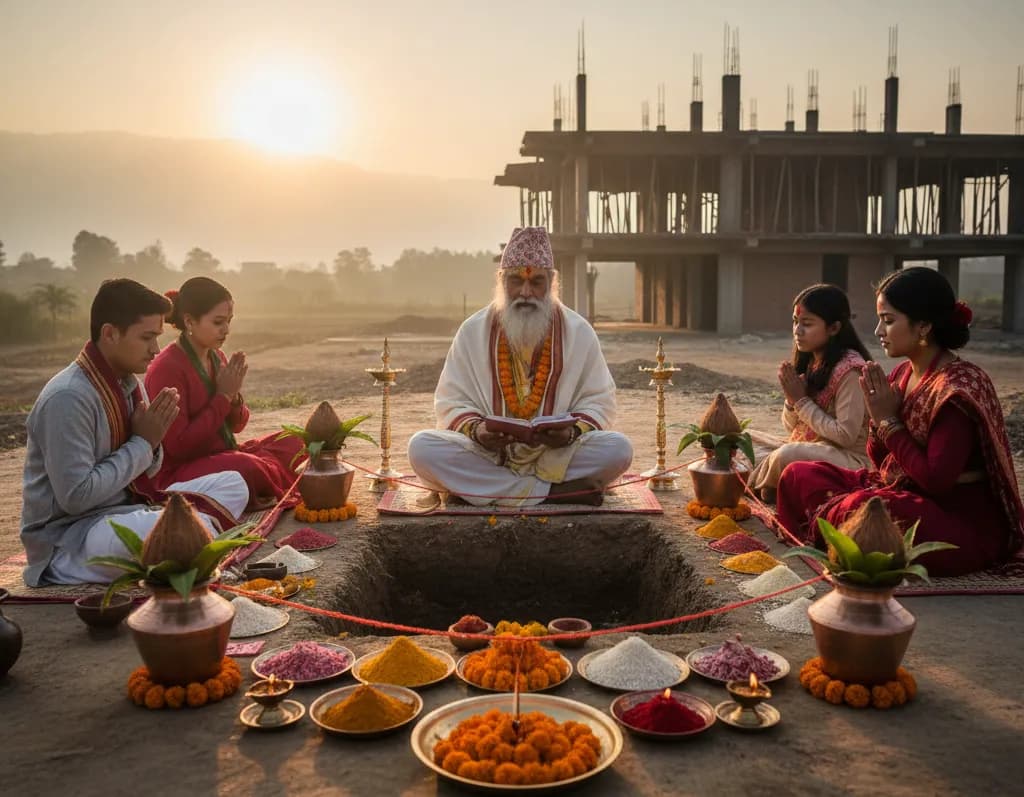
Jag Puja (जग पूजा), also called Bhoomi Puja or Bhumi Puja, is the ritual worship and consecration of the earth or ground. The term "Jag" in the Nepali/Hindi context refers to the earth, ground, or a specific plot of land. This puja seeks permission from and offers gratitude to Bhumi Devi (Earth Goddess) and various earth-dwelling deities before utilizing land for any purpose.
It is one of the foundational rituals before Griha Pravesh, Bhoomi Puja, Vaastu rituals, or construction work.
The ritual achieves several simultaneous objectives:
-
Purification of the Land: The ground is ritually cleansed and consecrated, transforming ordinary soil into a spiritually prepared space suitable for sacred construction.
-
Seeking Earth’s Permission: The ritual respectfully asks approval from Prithvi, Vastu Purusha, and Shesha Naga before disturbing the land or beginning any work.
-
Energy Stabilization: The buried kalas act as permanent energy anchors, protecting the structure and ensuring a balanced, harmonious energy flow.
-
Directional Protection: Kalas placed in the four directions invoke the blessings of the Dikpalas, forming a protective, multidimensional energy shield around the site.
Scriptural Foundation of Jag Puja
Jag Puja's sacred status emerges from the deepest layers of Hindu spiritual tradition, with references spanning from the oldest Vedas to contemporary Vastu Shastra texts.
Vedic References to Earth and Ground Sanctification
The Atharvaveda contains the Prithvi Sukta, an entire hymn dedicated to the Earth Goddess, celebrating her as the foundation of all existence. Key verses describe:
"She whom the Asvins measured out, o'er whom the foot of Vishnu strode, Whom Indra, Lord of Power and Might, freed from all foemen for himself, May Earth pour out her milk for us, a mother unto me her son."
This ancient hymn establishes that preparing and honoring the earth before disturbing it is a Vedic practice of profound antiquity. The language suggests that even in times when Indra (the king of gods) sought blessings before taking actions affecting the earth.
The Rigveda references the earth as "Aghnya" (not to be violated) and emphasizes that permission must be sought from the earth before any construction or disturbance. The concept of "Bhumi Puja" (earth worship) appears throughout Vedic rituals, establishing the principle that earth is not inert matter but a conscious, living entity deserving reverence.
Puranic Elaboration of Ground Consecration
The Garuda Purana, Skanda Purana, and Agni Purana contain detailed descriptions of ground consecration rituals that form the foundation of modern Jag Puja practice. These texts specifically prescribe:
The direction where foundation trenches should be dug (preferably northeast, where Vastu Purusha's head resides)
-
The lunar timing is most auspicious for such work
-
The deities to be invoked for the protection of the ground and structure
-
The substances to be buried to create permanent energy anchors
The Matsya Purana describes how the five elements should be represented in ground consecration ceremonies and how the four cardinal directions must be honored simultaneously for comprehensive protection.
Vastu Shastra: The Science of Sacred Architecture
Vastu Shastra, the ancient Indian science of architecture and spatial harmony, places Jag Puja as the foundational ritual preceding all construction. The Mayasabha and Bhujangollekha (classical Vastu texts) dedicate extensive passages to:
-
The preparation and blessing of the earth before construction
-
The mystical significance of burying sacred objects in foundation trenches
-
The role of the eight Dikpalas in protecting constructed spaces
-
The proper orientation of Vastu Purusha relative to the cardinal directions
These texts establish that without proper ground consecration, all subsequent construction, no matter how technically perfect, lacks spiritual foundation and energetic harmony.
Smrti (Dharma) Literature
Texts like Yajnavalkya Smrti and Brihaspati Smrti prescribe ground consecration as a dharmic duty before any construction that disturbs the earth. They classify failure to perform such rituals as a transgression requiring expiatory rites afterward, establishing the legal and moral obligation to honor the earth.
Understanding the Spiritual Entities in Jag Puja
Jag Puja's power derives from invoking four primary cosmic forces, each governing different aspects of ground consecration and structural harmony.
Prithvi: The Earth Goddess (भूमि देवी)
Prithvi, the Earth Goddess, embodies fertility, nourishment, grounding, and the very foundation on which all life exists.
-
Cosmic Mother: She is honored as the universal mother who supports and sustains every living being with unconditional care and stability.
-
Living Consciousness: In Hindu philosophy, the earth is not inert soil but a conscious divine presence capable of blessing, nurturing, or withdrawing support.
-
Stability & Grounding: Prithvi represents firmness, security, and the grounding energy essential for any structure built on her surface.
-
Creative Fertility: Her power to transform a seed into abundant life symbolizes manifestation, growth, and material prosperity.
-
Role in Jag Puja: During the ritual, mantras seek her permission to disturb the land and request her blessings. Offerings are made to honor her dominion and invite her stabilizing energy into the new construction.
Vastu Purusha – Spirit of the Dwelling (Vāstu Purusha)
Vastu Purusha is the cosmic being who governs all constructed spaces, making his invocation essential in Jag Puja.
-
Mythic Origin: Born during a great cosmic battle, he became the divine vessel through which gods channel harmony, order, and energy into man-made structures.
-
Cosmic Body Across the Land: He is visualized lying face-down over the plot, with each part of his body aligned to specific directions and energies:
-
Northeast (Head): Spiritual purity
-
East (Face): Vitality & illumination
-
Southeast (Right Arm): Fire & action
-
Center (Heart/Brahmasthana): Divine core
-
Northwest (Left Arm): Movement & air
-
South (Abdomen): Strength & grounding
-
Southwest (Legs): Stability
-
West (Genitals): Creativity & water element
-
Four Corners (Feet): Energetic anchoring
-
Vastu Purusha Mandala: His form is represented as a grid (9×9, 16×16, 64×64), with each square reflecting a body part and its energy. Kala placement during Jag Puja honors these zones and brings harmony to the land.
-
Role in Jag Puja: The ritual seeks Vastu Purusha’s permission before disturbing the land, ensures the building aligns with his energetic anatomy, and invites his protection over the future structure.
The Eight Dikpalas: Guardians of Directions (दिक्पाल)
The eight cardinal and intercardinal directions are each guarded by powerful deities called Dikpalas (literally "guardians of direction"). These eight cosmic forces create a protective sphere around the land and structure.
|
Direction |
Dikpala |
Divine Attribute |
Energy Quality |
|
East |
Indra |
Thunder, Victory, Power |
Illumination, New Beginnings |
|
West |
Varuna |
Waters, Purification |
Flow, Emotional Balance |
|
North |
Kubera |
Wealth, Prosperity |
Abundance, Northern Magnetic Pole |
|
South |
Yama |
Mortality, Law, Order |
Discipline, Southern Grounding |
|
Northeast |
Shiva/Eshanya |
Spirituality, Meditation |
Highest Spiritual Energy |
|
Southeast |
Agni |
Fire, Transformation |
Purification, Energy Release |
|
Southwest |
Nirrti |
Dissolution, Removal |
Cleansing of Negativity |
|
Northwest |
Vayu |
Air, Movement, Breath |
Circulation, Life Force |
Invocation in Jag Puja: Each Dikpala is ritually invoked at their corresponding cardinal point. The kalas placed in the four corners specifically anchor the protection of the primary Dikpalas (Indra, Varuna, Kubera, Yama) while simultaneously honoring the four intercardinal guardians.
Why the Earth Deserves Sacred Acknowledgment
Hindu tradition views the earth not as a lifeless resource but as a conscious, sacred being whose well-being directly influences human life.
-
Ancient Ecological Wisdom: Long before modern environmental science, Hindu teachings recognized that harming the earth harms all who depend on her. Treating land with respect ensures balance, health, and sustainability.
-
Energy Exchange: Reality is understood as a flow of energy. In Jag Puja, humans seek permission, offer gratitude, and honor the earth, receiving stability and protective blessings in return.
-
Energetic Foundation: The ground beneath a structure carries subtle energies. The materials buried in kalas (seeds, metals, water, gems) activate long-lasting energetic circuits that protect and harmonize the building.
-
Spiritual Continuity: Performing Jag Puja connects the practitioner to an ancestral lineage that treated construction as a sacred act. It honors thousands of years of accumulated wisdom about living in harmony with the earth.
The Five Sacred Elements in Ground Consecration
Jag Puja incorporates the five elements (Panchabhutas), each represented through specific materials and their placement.
-
Earth (Prithvi): Symbolized by the soil itself and cow-dung paste used for purification. It provides grounding, stability, and support to the future structure.
-
Water (Jala): Holy water, ideally from multiple sacred rivers or purified water mixed with Gangajal, fills the kalas, representing cleansing, flow, and prosperity.
-
Fire (Agni): Present through the ghee lamp and dhoop/incense. Fire purifies the surroundings, transforms energy, and uplifts the vibration of the space.
-
Air (Vayu): Reflected in the movement of incense smoke, natural wind, and the breath of mantra-chanting participants. It symbolizes life force, circulation, and balance.
-
Ether/Space (Akasha): Represented by the open sky, the emptiness within the kalas, and the surrounding cosmic space. Akasha embodies infinite potential and the subtle field from which creation emerges.
Jag Puja in Regional Traditions
While the core principles remain consistent, Jag Puja manifests differently across Hindu-practicing regions, with particularly strong traditions in Nepal.
Nepali Tradition
In Nepal, where Jag Puja is known as Jag khānu or Jag rākhnu, the ritual holds a central place in Karmakanda. Key features include:
-
Four-Kala System: Exactly four kalas are buried in the four cardinal directions, honoring the Dikpalas.
-
Precise Timing: Priests rely on the Nepali Panchang, selecting auspicious tithis, nakshatras, and strictly avoiding Rahukal.
-
Rahu & Naga Alignment: The direction of digging follows astrological rules related to Rahu and Naga head positions for energetic harmony.
-
Witness Mandap: A temporary mandap is often set up to create a sacred enclosure for the ritual.
Indian Regional Variations
-
North India: Focus on accurate Vastu-based pit measurements and a Navagraha Havan performed after consecration.
-
South India: Rich Abhishekam rituals, temple-style procedures, and advanced astronomical calculations.
-
East India (Shakta Regions): Strong goddess integration, use of sindoor in soil, and emphasis on Shakti energy.
-
Western India: Practices tied to agricultural cycles, cow protection, and land fertility traditions.
Jag Puja and the Modern Diaspora
For NRNs (Non-Resident Nepalis) and diaspora Hindus, Jag Puja represents an especially critical bridge to authentic spiritual practice during construction endeavors abroad.
Maintaining Authenticity
Constructing a home is among the most significant acts of creation a family undertakes. Performing Jag Puja connects diaspora practitioners to:
-
Unbroken ritual tradition stretching back thousands of years
-
The specific spiritual and astrological wisdom of their regional tradition
-
A sense of cultural continuity across geographical distance
-
Ancestral permission and blessings for new creation
Practical Challenges Abroad
Outside Nepal and India, diaspora families face significant obstacles:
Sourcing Authentic Materials: Finding genuine kalas, sacred water, and traditional items requires access to specialized suppliers or import from Nepal/India.
Priest Availability: Most Western countries lack priests trained in traditional Jag Puja procedures according to Nepali Karmakanda standards.
Astrological Calculations: Determining exact auspicious timing requires consultation with a qualified jyotishi (astrologer) versed in traditional Nepali calendar systems.
Community Participation: In traditional settings, Jag Puja involves community witnessing and collective blessing. Diaspora contexts often lack this community dimension.
Solutions for Diaspora Practice
Several approaches enable authentic practice:
-
Online Rituals: Priests in Nepal perform the entire Jag Puja via livestream, including the family’s name and address in the Sankalp.
-
Shipped Sacred Materials: Pre-consecrated kalas and ritual items can be shipped abroad so families can complete parts of the ritual locally.
-
Hybrid Method: A portion of the ritual is performed in Nepal, followed by complementary blessings at the construction site abroad.
-
Astrological Guidance: Remote astrologers select auspicious Nepali lunar dates, which are then coordinated with service providers.
Scientific Dimensions and Traditional Wisdom Integration
While Jag Puja's primary significance is spiritual and cultural, certain aspects align with observable principles:
-
Electromagnetic Effects: Metals like copper and silver in the kalas naturally conduct electromagnetic fields, possibly creating subtle energetic patterns around the structure.
-
Water & Mineral Interaction: Sacred water mixed with minerals from metals and gemstones may change in subtle ways; some studies suggest mantra vibrations can influence water structure.
-
Soil Stability: Proper excavation and the symbolic presence of underground water sources (through the kalas) can support better soil stability.
-
Psychological Impact: The ritual marks a mental shift, helping participants treat the land as sacred, which influences long-term care of the space.
-
Caveat: These ideas are supportive, not central. Jag Puja’s core value is spiritual and cultural, not scientific, and its effects cannot be fully measured through material science.
Ethical Considerations in Ground Consecration
Modern practitioners highlight that performing Jag Puja also creates ethical obligations aligned with its spiritual values:
-
Ethical Construction: The ritual commits builders to fair labor practices, sustainable materials, and environmentally responsible methods.
-
Rightful Land Ownership: Jag Puja assumes the land is obtained ethically; performing it on disputed or unjustly acquired property contradicts its purpose.
-
Community Respect: Construction should not harm neighbors, disrupt communities, or violate shared rights, doing so opposes the ritual’s intention of harmony.
-
Environmental Care: Reverence for the earth implies protecting ecosystems, reducing pollution, and building sustainably.
-
Safety & Integrity: Proper engineering and adherence to building codes honor the earth’s support and protect future occupants.
Modern Relevance of Ancient Practice
Despite its ancient origins, Jag Puja addresses needs that remain vital today:
-
Intentional Creation: In a world of rapid, unconscious building, the ritual fosters deliberate, sacred awareness in construction.
-
Connection to Place: Learning the land’s history, energy, and orientation deepens understanding and respect for the environment.
-
Respecting Disturbance: Acknowledges the impact of construction on ecosystems and energetic fields, emphasizing permission and ethical consciousness.
-
Spiritual Grounding: Ritual engagement with earth balances modern life’s abstraction and disconnection.
-
Family & Continuity: Marks transitions and growth, creating a ceremonial legacy for future generations.
Scriptural Foundation
Jag Puja's sacred status is deeply rooted in Vedic and Puranic literature:
Vedic References
-
Prithvi Sukta (Atharva Veda 12.1): This entire hymn is dedicated to Earth as the divine mother. Verses like "Mata Bhumih Putro Aham Prithivyah" (Earth is my mother, I am her son) establish the parent-child relationship with Earth.
-
Rigveda References: Multiple hymns praise earth's sustaining power and invoke her blessings for prosperity and stability.
-
Yajurveda: Contains mantras for seeking earth's forgiveness before agricultural activities or construction.
Puranic Mentions
-
Vishnu Purana: Describes Bhumi Devi as one of Lord Vishnu's consorts, rescued by Him in His Varaha (boar) avatar, establishing her exalted divine status.
-
Bhagavata Purana: Contains the famous narrative of Earth approaching Vishnu for relief from burden, showing her as an active divine participant in cosmic affairs.
-
Agni Purana: Provides detailed procedures for various types of Bhoomi Puja, including timing, materials, and mantras for different purposes.
-
Garuda Purana: Specifies Jag Puja as essential before constructing homes, temples, or establishing settlements
Architectural Texts
-
Vastu Shastra: Ancient architectural science mandates Bhoomi Puja before any construction. Texts like Mayamata and Manasara detail elaborate earth consecration procedures.
-
Brihat Samhita: Varahamihira's comprehensive text includes chapters on proper land selection and consecration rituals.
-
Smrti Literature
-
Manu Smrti and Yajnavalkya Smrti: Prescribe earth worship as part of Panchamahayajna (five great sacrifices) that householders must perform
Why Jag Puja Matters: Spiritual and Practical Significance
Spiritual Dimensions
-
Acknowledging Interconnectedness: The ritual recognizes we're part of nature's web, not separate from or superior to it.
-
Karmic Purification: Any earth disturbance affects countless life forms. Jag Puja seeks to minimize negative karmic accumulation by acknowledging and asking forgiveness.
-
Divine Permission: Rather than assuming ownership, the ritual seeks divine permission to use land, maintaining a proper spiritual relationship with creation.
-
Alignment with Dharma: Using resources without gratitude and acknowledgment violates dharma. Jag Puja restores the right relationship.
-
Protection Invocation: By properly consecrating land, protective deities are invoked to guard the space and those who will occupy it.
Practical Manifestations
Traditional belief holds that properly consecrated land yields:
-
Construction Stability: Buildings on consecrated ground face fewer structural issues and calamities.
-
Obstacle Reduction: Projects on properly blessed land encounter fewer unexpected delays and problems.
-
Prosperity: Businesses and homes on consecrated ground experience greater success and harmony.
-
Health Benefits: Occupants of properly blessed spaces enjoy better health and mental peace.
-
Generational Continuity: Property blessed through Jag Puja sustains families across generations with fewer disputes.
Social Share: