Navagraha Puja: Complete Guide
2026-02-16
32 min read
Navagraha Puja (नवग्रह पूजा) is the sacred ritual worship of the Nine Celestial Influencers (Navagraha), the seven visible planets plus the two lunar nodes, that profoundly influence human destiny, personality, health, and life experiences according to Vedic astrology and Hindu spiritual tradition.
The term Navagraha is derived from:
-
Nava (नव) = Nine
-
Graha (ग्रह) = Planet, "seizing," "laying hold of," "holding."
The fundamental understanding in Vedic philosophy is that these nine celestial bodies are not merely physical objects but divine entities with conscious influence—they literally "seize" and "hold" the destinies of beings on Earth through their gravitational, electromagnetic, and subtle energetic effects.
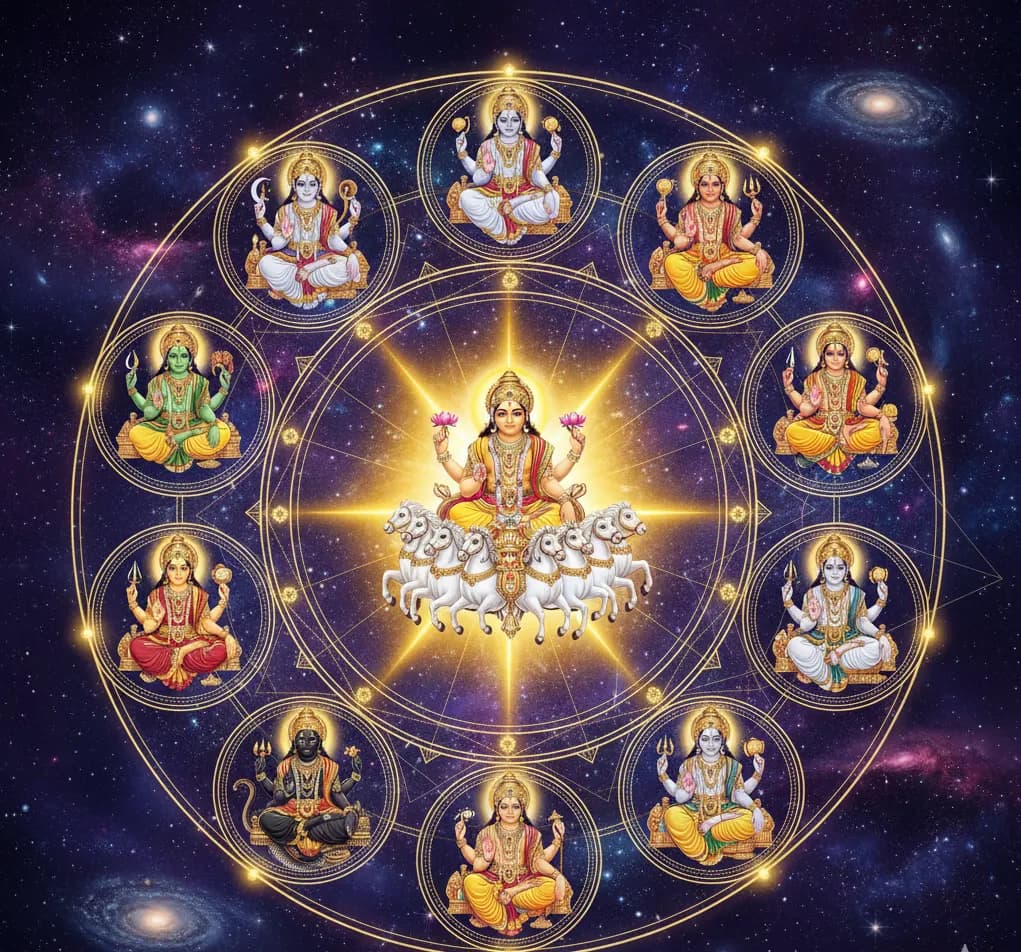
The Nine Celestial Bodies (Navagraha) are:
-
Surya (सूर्य) = Sun
-
Chandra (चंद्र) = Moon
-
Mangala (मंगल) = Mars
-
Budha (बुध) = Mercury
-
Brihaspati (बृहस्पति) = Jupiter
-
Shukra (शुक्र) = Venus
-
Shani (शनि) = Saturn
-
Rahu (राहु) = North Lunar Node (shadow planet)
-
Ketu (केतु) = South Lunar Node (shadow planet)
Purpose and Function of Navagraha Puja
Navagraha Puja serves multiple interrelated spiritual and practical purposes:
Planetary Pacification (Graha Shanti):
When planets are afflicted in a person's horoscope (creating "doshas" or afflictions), their negative influence can cause obstacles, delays, losses, health problems, and suffering. Navagraha Puja formally invokes each planet's blessings and seeks their pacification, reducing malefic effects.
Balancing Planetary Energies:
Each planet represents specific life domains and personality traits. Their proper balance ensures harmony across all areas of life—health, wealth, relationships, career, intellect, and spirituality. Puja coordinates and harmonizes these energies.
Invoking Planetary Blessings:
Beyond merely removing obstacles, Navagraha Puja actively invokes each planet's positive qualities and blessings. The properly pacified planets bestow their beneficial energies toward the devotee's success, health, wisdom, and spiritual progress.
Karmic Debt Resolution:
In Hindu philosophy, planetary afflictions often represent karmic debts from past actions. Sincere worship through Navagraha Puja is believed to help resolve these karmic obligations, accelerating spiritual evolution.
Protective Shield Against Planetary Transits:
Planetary movements create continuous changes in a person's horoscope. Regular Navagraha worship creates a protective energetic shield that helps navigate difficult planetary periods (dashas) with greater ease and grace.
Scriptural Foundation of Navagraha Worship
Vedic References:
The Vedas acknowledge celestial bodies as divine powers influencing human affairs. The Rigveda contains hymns to various celestial deities, establishing their divine status.
Puranic Elaboration:
The Puranas, particularly the Surya Purana, Chandra Purana, and others, contain detailed cosmological and mythological information about each Graha (planet). They describe:
-
Each planet's origin and divine nature
-
Relationship to major deities
-
Specific influence on human life
-
Methods of propitiation and worship
-
Stories illustrating planetary influence on human destiny
Jyotisha Shastra (Vedic Astrology):
The comprehensive system of Vedic astrology (Jyotisha), considered the "eye of the Vedas," is built entirely on the understanding that planetary positions determine:
-
Birth chart (Kundali)
-
Destiny and life path
-
Personality traits
-
Health tendencies
-
Career aptitudes
-
Relationship compatibility
-
Auspicious timing for all undertakings
Navagraha Stotra:
The most important classical text on Navagraha worship is the Navagraha Stotra (also called Navagraha Ashtakam or Navagraha Kavacham), traditionally attributed to the sage Vyasa. This composition contains nine verses (one for each planet) in which each Graha is formally invoked, praised, and propitiated. The recitation of this stotra is considered the heart of Navagraha worship.
The Nine Celestial Bodies: Individual Characteristics and Significance
Understanding each Graha's unique nature and influence is essential for appreciating Navagraha Puja's comprehensive approach.
1. SURYA (Sun) - सूर्य
Vedic Name and Meaning:
Surya means "the bright one," "that which generates," representing the primordial light and energy source.
Cosmic Function:
Creator of all visible light, time keeper, center of the solar system, sustainer of all life.
Astrological Significance:
-
Represents: Soul (Atman), life force, vitality, strength, courage, authority, leadership
-
Domain: Career, authority, fame, recognition, political power, father-related matters
-
Day: Sunday
-
Direction: East
-
Color: Golden, Red-orange
-
Element: Fire (Agni)
-
Nature: Benefic when well-placed; General malefic when afflicted
-
Associated Deity: Surya Narayana
Physical Characteristics (in artistic representations):
-
Complexion: Golden or copper-red
-
Vehicle: Seven-horse chariot (representing seven rays of light)
-
Weapons: Sword, bow
-
Associated symbols: Lotus
Spiritual Significance:
Surya represents the divine spark within each being—the eternal consciousness that illuminates existence. Worship of Surya connects the individual consciousness with cosmic consciousness, bringing clarity, strength, and illumination.
In Daily Life, Surya Influences:
-
Physical health and vitality
-
Eye health and vision (literal and metaphorical)
-
Ability to lead and command respect
-
Father-son relationships
-
Government jobs and bureaucratic success
-
Recognition and prestige
-
Will power and determination
Surya Dosha (Afflictions) Manifest As:
-
Career stagnation despite qualifications
-
Conflicts with authority figures and superiors
-
Lack of recognition for accomplishments
-
Government job difficulties
-
Eye problems and vision disorders
-
Weak health and low vitality
-
Arrogance and ego-driven behavior
-
Father-related estrangement or problems
Surya Stotra (From Navagraha Stotra):
"Japa Kusuma Sankasham Kasyapeyam Mahadyutim
Tamo Ari Sarva Pap Ghnam Pranato Asmi Divakarum"
Translation: "I salute the Sun, who is as effulgent as the hibiscus flower, born of Kashyapa, endowed with great splendor, the enemy of darkness, and the destroyer of all sins."
2. CHANDRA (Moon) - चंद्र
Vedic Name and Meaning:
Chandra means "the shining one," and Soma refers to the divine nectar. The Moon represents the cool, nourishing principle.
Cosmic Function:
Regulator of tides, water cycles, and all lunar-dependent phenomena; stabilizer of Earth's axial tilt.
Astrological Significance:
-
Represents: Mind (Manas), emotions, intuition, motherhood, nurturing
-
Domain: Mental peace, motherhood, family, domestic happiness, emotional well-being, memory
-
Day: Monday
-
Direction: Northwest
-
Color: White, Pearl
-
Element: Water (Jala)
-
Nature: General Benefic when well-placed; Malefic when afflicted
-
Associated Deity: Soma, Chandramauleshwara
Physical Characteristics:
-
Complexion: White or pearl
-
Vehicle: Chariot drawn by white horses or antelope
-
Associated symbols: Crescent moon, lotus
Spiritual Significance:
The Moon represents the reflective mind—the capacity to receive and process impressions from the outer world. Chandra worship develops emotional intelligence, intuitive wisdom, and the capacity for devotion.
Chandra Dosha Manifests As:
-
Mental restlessness and anxiety
-
Mood swings and emotional instability
-
Poor memory and learning difficulties
-
Mother-related problems or maternal health issues
-
Insomnia and sleep disturbances
-
Fertility challenges
-
Weak family relationships
-
Indecision and lack of confidence
Chandra Stotra (From Navagraha Stotra):
"Dadhi Shankha Tushar Abham Kshiroda Arnava Sambhavam
Namami Shashinam Somam Sambhor Mukuta Bhushanam"
Translation: "I salute the Moon, white as curd, conch, and snow, born from the ocean of milk, the ornament of Lord Shiva's crown."
3. MANGALA (Mars) - मंगल
Vedic Name and Meaning:
Mangala means "auspicious," representing the warrior principle and aggressive action in service of righteousness.
Cosmic Function:
The planet of transformation and energy represents the principle of action and force in the universe.
Astrological Significance:
-
Represents: Courage, strength, aggression, sexuality, military power, war
-
Domain: Siblings, real estate, property, courage, physical strength, aggression, accidents
-
Day: Tuesday
-
Direction: South
-
Color: Red
-
Element: Fire (Agni)
-
Nature: Lesser Malefic when afflicted; Beneficial for courage and property when well-placed
-
Associated Deity: Kartikeya (Skanda), Hanuman
Physical Characteristics:
-
Complexion: Red or copper
-
Vehicle: Chariot drawn by red horses or rams
-
Weapons: Lance, sword, mace
-
Symbols: Blood-red color, forceful energy
Spiritual Significance:
Mangala represents the principle of righteous aggression, the warrior spirit that fights against injustice and evil. Properly channeled, Mars energy becomes courage, determination, and protective strength.
In Daily Life, Mangala Influences:
-
Physical strength and athletic ability
-
Courage and bravery
-
Sibling relationships
-
Property ownership and real estate success
-
Military and police career success
-
Ability to defend against enemies
-
Sexual energy and reproductive health
-
Passion and enthusiasm
Mangala Stotra (From Navagraha Stotra):
"Dharani Garbha Sambhutam Vidyut Kanti Samaprabham
Kumaram Shakti Hastam Tam Mangalam Pranamy Aham"
Translation: "I salute Mars, born from the womb of Earth, brilliant as lightning, forever young, bearing the divine spear."
4. BUDHA (Mercury) - बुध
Vedic Name and Meaning:
Budha means "the wise one," representing intelligence, communication, and commerce.
Cosmic Function:
The messenger planet, closest to the Sun, represents quick intelligence and rapid communication.
Astrological Significance:
-
Represents: Intellect, communication, commerce, writing, mathematics, siblings
-
Domain: Business, trade, education, mathematics, communication, writing, commerce
-
Day: Wednesday
-
Direction: North
-
Color: Green
-
Element: Earth (Prithvi)
-
Nature: General Benefic; Lesser Malefic when severely afflicted
-
Associated Deity: Ganesha, Saraswati
Physical Characteristics:
-
Complexion: Green or yellow-green
-
Vehicle: Chariot or lion
-
Symbols: Writing instruments, trade goods
Spiritual Significance:
Budha represents the discriminative intellect—the capacity to analyze, differentiate, and understand. Mercury worship develops sharp intellect, clear communication, and practical wisdom.
In Daily Life, Budha Influences:
-
Intellectual ability and analytical skills
-
Communication skills and writing ability
-
Business and commerce success
-
Mathematical and computational ability
-
Educational achievement
-
Trade and commercial transactions
-
Relationship with cousins and siblings
-
Nervous system health
Budha Stotra (From Navagraha Stotra):
"Priyamgu Kalika Shyamam Rupena Apratimam Budham
Saumyam Saumya Gunopetam Tam Budham Pranamy Aham"
Translation: "I salute Mercury, dark as the bud of the priyangu flower, incomparably beautiful, gentle, and endowed with auspicious qualities."
5. BRIHASPATI (Jupiter) - बृहस्पति
Vedic Name and Meaning:
Brihaspati means "lord of speech" or "the great one." Jupiter is called Guru (teacher) in astrology.
Cosmic Function:
The largest planet, representing growth, expansion, and benevolence.
Astrological Significance:
-
Represents: Wisdom, knowledge, dharma, righteousness, wealth, expansion, children
-
Domain: Education, spirituality, children, prosperity, wealth, marriage, righteousness
-
Day: Thursday
-
Direction: Northeast
-
Color: Yellow, Gold
-
Element: Space/Ether (Akash)
-
Nature: Greatest Benefic planet
-
Associated Deity: Indra, Brihaspati
Physical Characteristics:
-
Complexion: Golden or yellow
-
Vehicle: Elephant or eagle
-
Symbols: Mala (prayer beads), scriptures, wealth
Spiritual Significance:
Jupiter represents divine wisdom and spiritual guidance. Brihaspati is the guru of the gods, symbolizing the principle of spiritual teaching, dharma (righteousness), and higher knowledge. Jupiter worship connects the devotee with spiritual guidance and wisdom.
In Daily Life, Brihaspati Influences:
-
Spiritual knowledge and wisdom
-
Children's welfare and education
-
Wealth and prosperity
-
Marriage and marital harmony
-
Career success and job advancement
-
Business expansion
-
Health and longevity
-
Luck and good fortune
Brihaspati Dosha (Afflictions) Manifest As:
-
Lack of children or infertility
-
Marriage delays or marital discord
-
Educational failures
-
Financial losses and poverty
-
Loss of wisdom and poor judgment
-
Liver diseases and obesity
-
Spiritual disconnect
-
Loss of luck and opportunity
Brihaspati Stotra (From Navagraha Stotra):
"Devanam Cha Rishinam Cha Gurum Kanchan Sannibham
Buddhimantam Trilokesham Tam Namami Brihaspatim"
Translation: "I salute Jupiter, the guru of gods and sages, golden in color, possessed of infinite wisdom, lord of the three worlds."
6. SHUKRA (Venus) - शुक्र
Vedic Name and Meaning:
Shukra means "the bright one," representing beauty, attraction, and desire.
Cosmic Function:
The planet of love, attraction, beauty, and material comforts in the material universe.
Astrological Significance:
-
Represents: Love, beauty, sexuality, attraction, luxury, wealth, pleasure, arts
-
Domain: Marriage, romance, luxury, arts, music, beauty, sexual pleasure, wealth
-
Day: Friday
-
Direction: Southeast
-
Color: White, Pink, Light Blue
-
Element: Water (Jala)
-
Nature: Lesser Benefic planet (beneficial, but can lead to excessive indulgence if afflicted)
-
Associated Deity: Mahalakshmi, Rajarajeswari
Physical Characteristics:
-
Complexion: White or pale
-
Vehicle: Horse or elephant
-
Symbols: Flowers, jewels, music instruments
Spiritual Significance:
Shukra represents the principle of attraction and desire. While typically associated with worldly pleasures, Venus also represents spiritual attraction, the soul's drawing toward divine love. Properly understood, Venus worship leads to appreciation of beauty as a manifestation of the divine.
In Daily Life, Shukra Influences:
-
Attractiveness and charisma
-
Romantic love and sexual attraction
-
Marriage and marital happiness
-
Arts, music, and creative expression
-
Luxury and material comforts
-
Wealth and financial prosperity
-
Sensual and aesthetic appreciation
-
Kidney and reproductive health
Shukra Dosha Manifests As:
-
Lack of attractiveness or charisma
-
Romantic relationship failures
-
Marriage delays or divorce
-
Lack of artistic ability
-
Financial losses and poverty
-
Excessive sexual indulgence or abstinence
-
Reproductive and urinary problems
-
Lack of appreciation for beauty
Shukra Stotra (From Navagraha Stotra):
"Himakund Mrinalaabham Daityanaaam Paramam Gurum
Sarva Shastra Pravaktaram Bhargavam Pranamy Aham"
Translation: "I salute Venus, white as a lotus born in snow-water, the supreme teacher of the demons, the expounder of all scriptures."
7. SHANI (Saturn) - शनि
Vedic Name and Meaning:
Shani means "the slow one," representing time, limitation, and discipline.
Cosmic Function:
The most distant planet from the Sun (in traditional astronomy), representing boundaries, time, karma, and justice.
Astrological Significance:
-
Represents: Discipline, karma, limitation, delay, hard work, justice, longevity
-
Domain: Work, career advancement through effort, justice, karmic debt, longevity
-
Day: Saturday
-
Direction: West
-
Color: Dark Blue, Black
-
Element: Air (Vayu)
-
Nature: Greater Malefic when afflicted; Benefic for discipline and spiritual advancement when well-placed
-
Associated Deity: Brahman, Mahakali, Kali
Physical Characteristics:
-
Complexion: Dark blue or black
-
Vehicle: Vulture or crow (dark birds)
-
Symbols: Scythe, sword, staff
-
Appearance: Aged, stern, serious
Spiritual Significance:
Saturn represents the principle of karma—the law of cause and effect. Shani teaches through limitation and difficulty, helping souls evolve through discipline and responsibility. Saturn is the great teacher of spiritual lessons through hardship.
In Daily Life, Shani Influences:
-
Career advancement through hard work
-
Discipline and responsibility
-
Longevity and old age health
-
Ability to bear hardship
-
Justice and legal matters
-
Karmic lessons and spiritual growth
-
Property and land ownership
-
Service and duty
Shani Dosha (Sade Sati, Saturn's 7.5-Year Transit) Manifests As:
-
Career obstacles and delays
-
Financial losses
-
Ill health and weakness
-
Relationship strains
-
Lawsuits and legal problems
-
Misfortune and bad luck
-
Mental suffering and depression
-
Loss and separation
Shani Stotra (From Navagraha Stotra):
"Nilanjana Samabhasam Ravi Putram Yamagrajam
Chaya Martanda Sambhutam Tam Namami Shaniswaram"
Translation: "I salute Saturn, dark as collyrium, son of the Sun, elder brother of Yama (death), born from the shadow of the Sun."
8. RAHU (Ascending Lunar Node) - राहु
Vedic Name and Meaning:
Rahu means "to take," representing grasping, ambition, worldly desires, and material pursuits.
Cosmic Function:
The North lunar node represents the ascending path of the Moon's orbit. Not a physical planet but a significant mathematical point with profound astrological influence.
Astrological Significance:
-
Represents: Ambition, worldly desires, illusion, confusion, technology, foreign connections
-
Domain: Ambition, worldly pursuits, foreign lands, technology, achievements through cunning
-
Color: Dark, Smoky
-
Element: Air (Vayu)
-
Nature: Shadow Planet, Generally Malefic; Can be beneficial if channeled positively
-
Associated Deity: Serpent, Kali, Durga
Mythological Background (The Churning of the Ocean Story):
According to Hindu mythology, during the churning of the cosmic ocean (Samudra Manthan), when the Devas and Asuras worked to obtain the nectar of immortality (Amrita), a demon named Svarbhanu drank the nectar disguised. When Vishnu discovered this deception, he severed the demon's head. The head became Rahu, and the body became Ketu. Eternally, Rahu pursues the Sun and Moon, trying to consume them, causing solar and lunar eclipses.
Spiritual Significance:
Rahu represents worldly illusion (Maya), ambition, and the tendency toward deception and manipulation. However, properly understood and channeled, Rahu represents the soul's drive toward worldly achievement and material success, the motivation that propels beings forward in material existence. Rahu worship helps refine ambition toward dharmic (righteous) pursuits.
In Daily Life, Rahu Influences:
-
Ambition and material success
-
Worldly desires and material pursuits
-
Foreign travel and international connections
-
Technology and modern pursuits
-
Cunning and intellectual manipulation
-
Sudden gains through unconventional means
-
Shadow economy and underground activities
-
Innovation and unconventional thinking
Rahu Dosha manifests as:
-
Confusion and delusion
-
Deception and dishonesty
-
Obsessive ambitions and greed
-
Foreign travel problems
-
Skin diseases and psychological disorders
-
Sudden losses or accidents
-
Divorce and relationship breakdowns
-
Negative planetary influence during Rahu Dasha (20-year period)
Rahu Beej Mantra:
"Om Bhram Bhrim Bhrom Sah Rahuve Namah"
9. KETU (Descending Lunar Node) - केतु
Vedic Name and Meaning:
Ketu means "the flag," representing spiritual awareness, liberation, and detachment.
Cosmic Function:
The South lunar node represents the descending path of the Moon's orbit. Complementary to Rahu, Ketu represents the spiritual trajectory.
Astrological Significance:
-
Represents: Spirituality, liberation, detachment, intuition, past-life karma, mysticism
-
Domain: Spiritual practices, meditation, mysticism, past-life patterns, liberation
-
Color: Smoky, Dark
-
Element: Fire (Agni)
-
Nature: Shadow Planet, Generally Malefic; Highly Beneficial for spiritual advancement when channeled properly
-
Associated Deity: Ganesha, Bhairav, Shiva
Mythological Background:
The body portion of the demon Svarbhanu (after his head was severed to become Rahu). Eternally moving in the opposite direction from Rahu, Ketu represents the counterforce—the soul's movement toward spiritual liberation and detachment from worldly pursuits.
Spiritual Significance:
Ketu represents karmic completion, spiritual wisdom gained through past incarnations, and the soul's inherent drive toward liberation. Ketu worship accelerates spiritual awakening and helps the soul transcend worldly attachments. Interestingly, many spiritual practitioners have strong Ketu placements, as Ketu propels the soul toward enlightenment.
In Daily Life, Ketu Influences:
-
Spiritual inclination and mysticism
-
Intuitive and psychic abilities
-
Detachment and renunciation
-
Completion of karmic cycles
-
Past-life memories and patterns
-
Isolation and solitude for spiritual practice
-
Unconventional spiritual paths
-
Research and investigation
Ketu Dosha Manifests As:
-
Confusion about life direction
-
Excessive detachment and isolation
-
Spiritual escapism
-
Past-life trauma affecting current life
-
Lack of direction and purpose
-
Chronic health conditions with unclear cause
-
Feelings of incompleteness
-
Negative manifestations during Ketu Dasha (7-year period)
Ketu Beej Mantra:
"Om Sram Srim Srom Sah Ketuve Namah"
Understanding Planetary Doshas and Afflictions
A Dosha (दोष) literally means "fault" or "defect." In Vedic astrology, a Navagraha Dosha occurs when a planet is afflicted in a person's horoscope through:
Unfavorable Placement:
-
Placement in houses where that planet is naturally weak
-
Placement in signs where the planet is in detriment or fall
-
Retrograde motion (planet appearing to move backward)
Difficult Aspects:
-
Being aspected by malefic planets
-
Conjunctions with other malefic planets
-
Angular separation creates discord
Dasha (Planetary Period) Activation:
Even an otherwise acceptable planetary placement becomes problematic during that planet's Dasha (20-year period) if it's significantly afflicted.
Common Major Planetary Afflictions:
|
Affliction |
Effects |
Remedies |
|
Kala Sarpa Yoga |
Rahu-Ketu axis creating extreme limitations |
Navagraha Puja, Kala Sarpa Puja |
|
Sade Sati |
Saturn's 7.5-year transit creating obstacles |
Saturn worship, Shani remedies |
|
Rahu Dasha |
18-year period of confusion and illusion |
Regular Rahu worship, Ketu meditation |
|
Ketu Dasha |
7-year period of spiritual/existential questioning |
Spiritual practice, Ketu worship |
|
Sun Dosha |
Authority and career obstacles |
Surya Namaskar, Sunday worship |
|
Moon Dosha |
Mental unrest and emotional instability |
Lunar worship, Monday fasting |
|
Mars Dosha |
Accidents, aggression, sibling conflict |
Mars worship, Tuesday remedies |
The Three Types of Navagraha Worship
Navagraha worship manifests in three primary forms:
1. Navagraha Stotra Recitation
The simplest and most accessible form, involving daily recitation of the Navagraha Stotra (the 9 verses describing each planet). Can be done individually, in family settings, or in communities.
2. Navagraha Shanti Puja (Planetary Peace Ritual)
A formal ritual involving:
-
Altar setup with nine deity representations or yantras
-
Individual invocation and worship of each planet
-
Mantras, offerings, and prayers
-
Sometimes includes Havan (fire ritual)
-
Typically performed by priests or experienced practitioners
3. Specialized Remedial Puja for Individual Planets
When a specific planet is severely afflicted, individual specialized pujas can be performed:
-
Surya Puja for Sun afflictions
-
Chandra Puja for Moon problems
-
Mangal Puja for Mars dosha
-
Budha Puja for Mercury issues
-
Jupiter Puja for Brihaspati afflictions
-
Venus Puja for Shukra issues
-
Shani Puja for Saturn dosha
-
Rahu Puja or Kali Puja for Rahu dosha
-
Ketu Puja or Ganesha Puja for Ketu dosha
Regional Traditions of Navagraha Worship
North Indian Tradition:
Strong emphasis on Graha Shanti pujas, particularly during difficult planetary transits (especially Sade Sati). Integration with Navaratri worship.
South Indian Tradition:
Temple-based Navagraha worship with 9 separate shrines (often arranged concentrically). Integration with Vaishnavism and Shaivism.
Nepali Tradition:
Ancient tradition with specific Navagraha temples, particularly honoring planetary deities. Strong connection to astrology-based temple worship.
Temple Examples:
-
Navgraha Temple, Guwahati (Assam, India): Dedicated to all nine planets with individual shrines
-
Sri Jogini Temple (Himachal Pradesh): Features Navagraha worship
-
Navagraha Temples in Nepal: Various locations throughout the Kathmandu Valley
Planetary Elements and Associations
Understanding the elemental and associational dimensions of each planet enhances the puja experience.
Elemental Associations (Pancha Tattva):
|
Planet |
Element |
Quality |
|
Sun |
Fire (Agni) |
Hot, Bright, Masculine |
|
Moon |
Water (Jala) |
Cool, Nurturing, Feminine |
|
Mars |
Fire (Agni) |
Hot, Aggressive, Masculine |
|
Mercury |
Earth (Prithvi) |
Neutral, Balanced |
|
Jupiter |
Space/Ether (Akash) |
Expansive, All-encompassing |
|
Venus |
Water (Jala) |
Cool, Attractive, Feminine |
|
Saturn |
Air (Vayu) |
Cold, Dry, Limiting |
|
Rahu |
Air (Vayu) |
Cold, Shadowy, Delusory |
|
Ketu |
Fire (Agni) |
Hot, Spiritual, Transformative |
Benefic vs. Malefic Nature:
|
Classification |
Planets |
Characteristics |
|
Greater Benefic |
Jupiter |
Universally beneficial; greatest fortune-giver |
|
Lesser Benefic |
Venus |
Beneficial but can lead to excess indulgence |
|
General Benefic |
Moon, Mercury |
Generally beneficial; can become malefic if afflicted |
|
General Malefic |
Sun |
Naturally neutral; can be positive or negative |
|
Lesser Malefic |
Mars, Ketu |
Challenging; requires discipline and proper direction |
|
Greater Malefic |
Saturn, Rahu |
Significantly challenging; require strong spiritual practice |
Modern Scientific Correlation with Ancient Understanding
While Vedic astrology is fundamentally spiritual rather than scientific, certain modern observations align with traditional understanding:
Lunar Influence on Life:
Modern science confirms that the Moon's gravitational pull affects tides, water bodies, and biological cycles. Many organisms' reproductive cycles synchronize with lunar phases.
Planetary Cycles and Psychology:
Some studies suggest that people born during specific planetary configurations show statistical correlations with personality traits (though causation remains unproven).
Electromagnetic Fields:
Planets and celestial bodies generate electromagnetic fields. Their positions may influence Earth's magnetosphere, which affects biological systems (though the mechanism is not fully understood).
Psychological Benefit of Ritual:
Regular ritual practice and belief in planetary influence create psychological states (expectation, focus, intention) that positively affect outcomes, demonstrating the power of consciousness in shaping reality.
Important Note: While these observations are interesting, Navagraha Puja's primary power and purpose is spiritual, working on dimensions of consciousness and karma that transcend material scientific measurement. The puja's effectiveness ultimately depends on sincere devotion and spiritual receptivity rather than material verification.
Why Navagraha Puja Matters in Modern Life
Despite living in a technologically advanced age, people continue to experience:
-
Career obstacles despite qualifications
-
Inexplicable relationship failures
-
Recurring health issues without a clear medical cause
-
Persistent financial struggles
-
Psychological suffering despite material success
-
Timing that seems uncannily bad for major undertakings
Navagraha Puja addresses these experiences by working on the subtle energetic and karmic dimensions that material solutions cannot access. By harmonizing one's relationship with the nine celestial influencers, practitioners often experience:
-
Unexpected synchronicities and opportunities
-
Improved timing for important endeavors
-
Better relationships and communication
-
Improved health and vitality
-
Resolution of chronic problems
-
Greater peace and mental clarity
-
Accelerated spiritual growth
This explains why Navagraha Puja remains as relevant in the 21st century as it was millennia ago—it addresses the essential dimension of existence that no amount of material progress can eliminate.
Social Share: