Lord Ganesha: Complete Guide
2026-02-16
12.8 min read
Lord Ganesha, the elephant-headed deity, stands as one of Hinduism's most beloved and widely worshipped gods. Known as Vighnaharta (remover of obstacles), Buddhipriya (lover of intelligence), and Prathampujya (first to be worshipped), Ganesha embodies wisdom, prosperity, and auspicious beginnings. This comprehensive guide covers Ganesha's origins, symbolism, worship traditions, and enduring relevance for devotees worldwide.
Who is Lord Ganesha?
Names and Epithets
Ganesha/Ganesh: "Gana" = group/multitude + "Isha" = lord. Lord of Ganas (Shiva's attendants) or Lord of Multitudes.
Ganapati: Same meaning, different construction. Particularly popular in Maharashtra and South India.
Vinayaka: "Vi" = without + "nayaka" = leader. The unrivaled leader, or one who removes obstacles.
Vighnaharta/Vighneshwara: "Vighna" = obstacle + "harta" = remover. The primary function—removing obstacles.
Ekadanta: "Eka" = one + "danta" = tusk. The one-tusked, referring to his broken tusk.
Lambodara: "Lamba" = hanging + "udara" = belly. The pot-bellied one.
108 Names: Like other major deities, Ganesha has 108 sacred names each highlighting different aspects.
Parentage and Family
Parents: Son of Lord Shiva and Goddess Parvati. Created by Parvati alone in most stories.
Brother: Kartikeya (also called Murugan, Skanda, Subramanya)—the warrior god.
Wives: In some traditions, married to Riddhi (prosperity) and Siddhi (spiritual power). In South Indian tradition, also married to Buddhi (wisdom).
Sons: Shubh (auspiciousness) and Labh (profit) in some Puranic accounts.
Celibate Tradition: Some traditions, especially in Maharashtra, consider Ganesha as bachelor (brahmachari).
Birth Stories
The Bathroom Guardian Story (Most Popular)
Parvati's Creation: Parvati, wanting to bathe privately, created a boy from turmeric paste (or sandalwood) rubbed from her body and breathed life into him.
The Instruction: She told him to guard the entrance and let no one enter.
Shiva's Return: When Shiva returned and tried to enter, the boy blocked him, not knowing who Shiva was.
The Confrontation: Shiva's attendants and even Shiva himself tried to pass, but the boy fought valiantly. Finally, Shiva, in anger, beheaded him.
Parvati's Grief: When Parvati emerged and saw what happened, she was devastated and furious.
The Solution: To pacify Parvati, Shiva promised to restore the boy. He sent attendants to bring the head of the first creature found sleeping with its head facing north. They found an elephant and brought its head.
Rebirth: Shiva placed the elephant head on the boy's body and revived him. He then adopted him as his own son and made him the leader of his ganas.
Symbolism of This Story
Independent Creation: Parvati created Ganesha without Shiva, representing Shakti's independent creative power.
Loyalty: Ganesha's absolute obedience to his mother's command, even against overwhelming force.
Death and Rebirth: Transformation through apparent destruction—spiritual lesson of ego death.
Elephant Head: The unusual form represents wisdom beyond normal human consciousness.
The Broken Tusk: Multiple Stories
Writing the Mahabharata
Vyasa's Request: Sage Vyasa needed a scribe who could write as fast as he could dictate the Mahabharata.
Ganesha's Condition: He agreed, but on condition that Vyasa never pause. Vyasa agreed, but added that Ganesha must understand each verse before writing it.
The Accident: During the dictation, Ganesha's pen broke. Without pausing (per the condition), he broke off his own tusk and used it as a pen to continue writing.
Symbolism: Sacrifice for knowledge; importance of completing what you start; using whatever tools are available.
The Moon Incident
The Curse: One night, Ganesha, after eating too many modaks, fell from his mouse vehicle. The moon laughed at him. Angry, Ganesha cursed the moon to wax and wane, losing its permanent fullness.
Throwing the Tusk: In some versions, Ganesha threw his tusk at the mocking moon.
Symbolism: Pride and humility; consequences of mockery; impermanence.
Fighting Parashurama
The Story: Parashurama (Rama with an axe), Vishnu's sixth avatar and Shiva's devotee, came to visit Shiva. Ganesha blocked him as Shiva was resting. They fought, and Parashurama threw his axe, a gift from Shiva. Out of respect for his father's gift, Ganesha let the axe strike him, breaking his tusk.
Symbolism: Respect for father; accepting pain from a respected source; humility before the guru's weapons.
Ganesha's Vehicle: The Mouse
Mooshika the Mouse
Origin Story: In some traditions, Mooshika was originally a demon or celestial being cursed to become a mouse. Ganesha defeated and tamed him, making him his vehicle.
Symbolism:
Mouse as Desire: Mice nibble constantly, representing endless desires. Ganesha riding the mouse shows control over desires.
Small Vehicle, Large God: Teaches humility; even the mightiest should remain humble.
Obstacle Remover: Mice can gnaw through anything persistently, making them a perfect vehicle for obstacle removers.
Accessibility: Unlike grand vehicles (Garuda, Nandi), a mouse goes everywhere, Ganesha is accessible to all.
Symbolism of Ganesha's Form
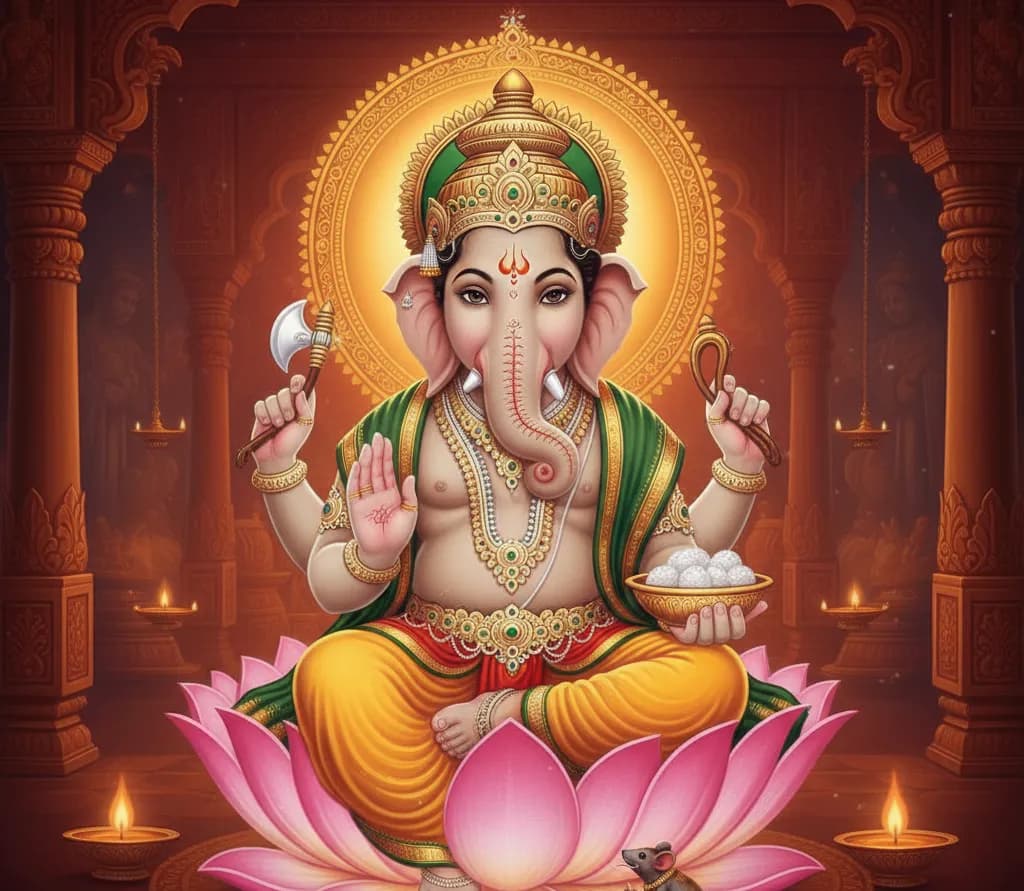
The Elephant Head
Large Ears: Listen to devotees' prayers; hear all perspectives; wisdom comes from listening.
Small Eyes: Focused concentration; seeing the essential, not distracted by the superficial.
Long Trunk: Discrimination (viveka), ability to distinguish between good and bad, real and unreal; flexibility in approach.
Single Tusk: Retaining the good (unbroken tusk), discarding the bad (broken tusk); one-pointed devotion.
The Body
Big Belly: Capacity to digest all experiences, good and bad, sweet and bitter, without disturbance. Also represents prosperity and completeness.
Modak in Hand: The sweet reward of spiritual seeking; the goal of effort.
Small Stature: Some depictions show child-like form, innocence, playfulness, and accessibility.
The Four Arms
Axe (Parashu): Cutting attachments, desires, and bonds; destroying obstacles.
Rope/Noose (Pasha): Pulling devotees toward truth; drawing them away from worldly entanglements.
Modak: Sweetness of realized self; reward for spiritual practice.
Abhaya Mudra: Hand gesture granting fearlessness and protection; blessing mudra.
Other Elements
Sacred Thread: Around the belly, sacred thread showing his Brahmin status or serpent (representing kundalini energy).
Tilak: Mark on forehead, third eye symbolism; divine consciousness.
Crown: Divine authority; spiritual kingship.
Ganesha as the First Deity to be Worshipped
Prathampujya Tradition
Universal Custom: No Hindu ceremony, puja, yajna, wedding, business opening, journey begins without first invoking Ganesha.
Even Gods Worship First: Even when worshipping other deities, Ganesha is invoked first.
Origin of This Practice
Shiva's Decree: After giving Ganesha the elephant head, Shiva declared he would be worshipped first in all ceremonies.
The Story: Ganesha and Kartikeya competed for who should be worshipped first. The challenge was to circle the universe. Kartikeya rushed off on his peacock. Ganesha, on his mouse, simply circled his parents (Shiva and Parvati) three times, explaining, "You are my universe." Impressed, Shiva granted him the honor of being worshipped first.
Practical Reason: As an obstacle remover, logical to invoke him first so the ceremony proceeds smoothly.
The Modak: Ganesha's Favorite Food
What is Modak?
Description: Sweet dumpling with rice flour or wheat flour outer shell, filled with coconut and jaggery mixture, steamed or fried.
Regional Variations:
-
Ukadiche modak (steamed), Maharashtra
-
Kudumu (Telugu)
-
Modakam (Tamil)
-
Different fillings, sesame, nuts, poppy seeds
Why Modak?
Mythology: Ganesha loves modaks. Devotees offer modaks to please him.
Symbolism:
-
Outer shell: Body/material world
-
Sweet filling: Soul/bliss within
-
Eating modak: Realizing inner sweetness beyond outer form
Ganesh Chaturthi: 21 modaks traditionally offered (some traditions specify 108).
Major Ganesha Festivals
Ganesh Chaturthi (Vinayaka Chaturthi)
Date: Chaturthi (4th day) of Shukla Paksha in Bhadrapada month (August-September).
Duration: Can be 1.5 days, 3, 5, 7, or 10 days, depending on region and tradition.
Maharashtra Tradition: Massive public celebration, community Ganesha installations, daily aartis, 10-day observance ending with immersion (visarjan).
Home Observance: Clay Ganesha idol installed, daily worship, immersion on chosen day.
Lokmanya Tilak's Innovation: Freedom fighter Bal Gangadhar Tilak transformed private worship into a public festival in the 1890s to build community unity against the British.
Modern Practice: Huge elaborate installations, especially in Mumbai, Pune, and other Maharashtra cities. Also widely celebrated in other states.
Sankashti Chaturthi
Monthly Observance: Chaturthi of Krishna Paksha (waning moon) each month.
Special Day: When Sankashti Chaturthi falls on Tuesday, called Angaraki Chaturthi, extra auspicious.
Fasting: Many devotees fast until moonrise, break fast after seeing the moon and performing puja.
Purpose: Regular monthly obstacle removal practice.
Vinayaka Chaturthi (Every Month)
Both Chaturtis: the 4th day of both waxing and waning fortnight are Ganesha's days.
Less Elaborate: Simpler observance than the main Ganesh Chaturthi, but still auspicious for Ganesha worship.
Regional Ganesha Traditions
Maharashtra
Cultural Icon: Ganesha is Maharashtra's most important deity. "Ganpati Bappa Morya" is the state's rallying cry.
Ashtavinayak: Eight sacred Ganesha temples in Maharashtra, Moreshwar (Morgaon), Siddhivinayak (Siddhatek), Ballaleshwar (Pali), Varadavinayak (Mahad), Chintamani (Theur), Girijatmaj (Lenyadri), Vighnahar (Ozar), Mahaganapati (Ranjangaon).
Siddhivinayak Temple: Mumbai's famous temple attracts celebrities, politicians, and millions of devotees.
Public Celebration: Ganesh Chaturthi is Maharashtra's biggest festival.
South India
Temples: Rockfort Ucchi Pillayar (Tamil Nadu), Kanipakam (Andhra Pradesh), Madhuban (Karnataka), major Ganesha temples.
Vinayaka Chaturthi: Celebrated with great devotion, especially in Tamil Nadu and Andhra Pradesh.
Different Iconography: Sometimes shown with wives Siddhi and Buddhi.
Cultural Integration: Ganesha worship is integral to daily life and major ceremonies.
Nepal
Every Temple: Nearly every Hindu temple in Nepal has a Ganesha shrine, often at the entrance.
Chandra Vinayak: Famous Ganesha temple in Chabahil, Kathmandu.
Integration: Ganesha worship is deeply integrated into Nepali Hindu practice.
Bengal
During Durga Puja, Ganesha is worshipped alongside Durga, Lakshmi, Saraswati, and Kartikeya in the panchayatan (group of five).
Lokkhi Pujo: Some families worship Lakshmi-Ganesha together regularly.
Ganesha in Scriptures
Vedic Connections
Rigvedic Ganapati: Mention of "Ganapati" in Rigveda, though unclear if the same as elephant-headed Ganesha.
Later Development: Clearly defined elephant-headed Ganesha emerges in the Puranic period.
Puranic References
Mudgala Purana: Entire Purana dedicated to Ganesha. Eight incarnations of Ganesha are described.
Ganesha Purana: Another complete Purana about Ganesha.
Shiva Purana: Contains detailed Ganesha birth stories.
Skanda Purana, Brahma Vaivarta Purana: Significant Ganesha episodes.
Ganesha-Focused Texts
Ganesha Sahasranama: 1000 names of Ganesha.
Ganesha Ashtottara: 108 names recited in worship.
Ganapati Atharvashirsha: Important Upanishadic text on Ganesha philosophy—often recited during worship.
Sankat Nashan Ganesh Stotra: Popular hymn for obstacle removal.
Ganesha Pancharatnam: Five verses by Adi Shankaracharya.
Ganesha Worship Practices
Daily Worship
Morning Invocation: Many Hindus begin the day by invoking Ganesha for an obstacle-free day.
Before Work: Students and professionals invoke Ganesha before important tasks.
Mantra Chanting: "Om Gam Ganapataye Namah" most popular.
Special Occasions
Before Major Events: Weddings, business openings, home entries (griha pravesh), journey beginnings.
Educational Milestones: First day of school, before exams, starting studies.
Problem Situations: When facing obstacles, seeking solutions, and needing clarity.
Forms of Worship
Simple: Lighting a lamp, offering flowers, chanting a mantra.
Moderate: Ashtottara recitation, specific offerings, aarti.
Elaborate: Full shodashopachar puja, Ganapati Atharvashirsha recitation, modak preparation, homa.
Modern Relevance
For Education and Career
Student Deity: Ganesha, as lord of intelligence, is students' primary deity worldwide.
Professional Beginnings: New jobs, promotions, career changes, modern equivalents of traditional "new beginnings."
Business Success: Entrepreneurs worship Ganesha for business success and obstacle removal.
For Modern Obstacles
Psychological Blocks: Fear, procrastination, lack of confidence, and modern "obstacles" Ganesha addresses.
Decision-Making: Seeking clarity in complex choices, Ganesha, as wisdom-give,r is relevant.
Life Transitions: Moving, divorce, career change, major transitions need Ganesha's guidance.
For Diaspora Hindus
Universal Symbol: Ganesha's friendly appearance and universal function make him Hinduism's most recognizable symbol globally.
Accessible Practice: Simple Ganesha worship is easy to maintain in non-Hindu environments.
Cultural Identity: Ganesh Chaturthi celebrations create Hindu community bonds abroad.
Child-Friendly: Children relate to Ganesha's friendly appearance, making him effective for transmitting culture to the next generation.
Philosophical Interpretations
Advaitic Understanding
Beyond Form: Ganesha's unusual form points to truth beyond conventional appearance.
Om Embodiment: Some see Ganesha's form as representing Om, curved trunk as 3, head and belly as O, etc.
Consciousness: As an obstacle remover, Ganesha represents discriminative consciousness that removes ignorance.
Tantric Ganesha
Bija Mantra: "Gam" (गं) is Ganesha's seed syllable, used in tantric practice.
Chakra Association: Related to Muladhara (root) chakra—foundation of spiritual journey.
Kundalini: Some traditions see Ganesha as representing the initial awakening of kundalini energy.
Lord Ganesha embodies Hinduism's practical wisdom, clear obstacles before starting, seeking intelligence over mere strength, remaining humble despite power, digest all life experiences. His worship isn't mere superstition but psychological practice: consciously addressing obstacles (external and internal), cultivating discrimination and wisdom, approaching new ventures with the right attitude.
For NRNs and diaspora Hindus, Ganesha provides an accessible entry point to Hindu practice, an easy-to-understand function, a friendly appearance, and no complex theology required. Whether preparing for exams, starting businesses, moving homes, or simply seeking wisdom in daily life, Ganesha remains relevant across cultures and circumstances.
The elephant-headed god continues to charm and help millions worldwide, proving that the most unusual form can carry the most universal truth: begin with wisdom, proceed with humility, and let no obstacle block your path to success.
Social Share: