Durga Saptashati (Devi Mahatmya): Complete Guide
2026-02-16
14 min read
Durga Saptashati, also called Devi Mahatmya or Chandi Path, is one of Hinduism's most powerful and revered scriptures, 700 verses glorifying the Divine Mother's triumph over demonic forces. This comprehensive guide covers the text's origins, the three demon-slaying episodes, deep symbolism, worship traditions, and why this ancient hymn remains the primary text of Shakta (Goddess-focused) Hinduism for devotees seeking protection, empowerment, and divine grace.
What is Durga Saptashati?
Durga Saptashati: "Saptashati" = seven hundred. The text contains 700 verses (shlokas) praising Goddess Durga.
Devi Mahatmya: "Mahatmya" = glory, greatness. "The Glory of the Goddess", emphasizing Devi's supreme power.
Chandi Path: "Chandi" = fierce, wrathful aspect of Devi. "Path" = reading, recitation. Commonly used in North India and Nepal.
All Three Names: Refer to the same text, 13 chapters from the Markandeya Purana, specifically glorifying the Divine Mother.
Scriptural Source
Markandeya Purana: One of the 18 major Puranas, narrated by sage Markandeya. The Saptashati forms chapters 81-93 of this Purana.
Approximate Dating: Most scholars place the composition between 400-600 CE, though tradition considers it much older, emerging in the Treta or Dwapara Yuga.
Narrative Frame: King Suratha (who lost his kingdom) and merchant Samadhi (betrayed by family) encounter sage Medhas in the forest. The sage narrates three episodes of Devi's demon-slaying to console and enlighten them.
The Three Demon-Slaying Episodes
Prathama Charitra (First Episode): Mahakali
Chapters 1-4 (175 verses)
The Crisis: At the beginning of creation, demons Madhu and Kaitabha emerged from the earwax of sleeping Vishnu. They threatened to destroy the universe before creation even began.
Devi's Intervention: Brahma prayed to Yoganidra (sleep personified as a goddess) to release Vishnu from divine sleep. She manifested as Mahakali.
The Battle: Vishnu awoke and fought the demons for 5,000 years. Finally, through Devi's grace and a clever boon trap, Vishnu killed them.
Symbolism:
-
Madhu and Kaitabha: Represent primal ignorance (tamas guna)
-
Divine Sleep: Cosmic unconsciousness before manifestation
-
Devi's Awakening: Consciousness awakening from dormancy
-
Victory: Destruction of fundamental ignorance, enabling creation
Form: Mahakali, dark, fierce, associated withthe tamas transformation.
Madhyama Charitra (Middle Episode): Mahalakshmi
Chapters 5-8 (225 verses)
The Crisis: Demon king Mahishasura (buffalo demon) defeated all gods through intense tapasya (penance) that gained him a boon: no man or god could kill him. He conquered heaven, earth, and the underworld. Gods were powerless.
Devi's Manifestation: All gods' combined energies manifested as the Goddess, each god contributed his essence:
-
Shiva's tejas → Devi's face
-
Vishnu's energy → Devi's arms
-
Indra's power → Devi's middle
-
Each god's weapon → Devi received the corresponding weapon
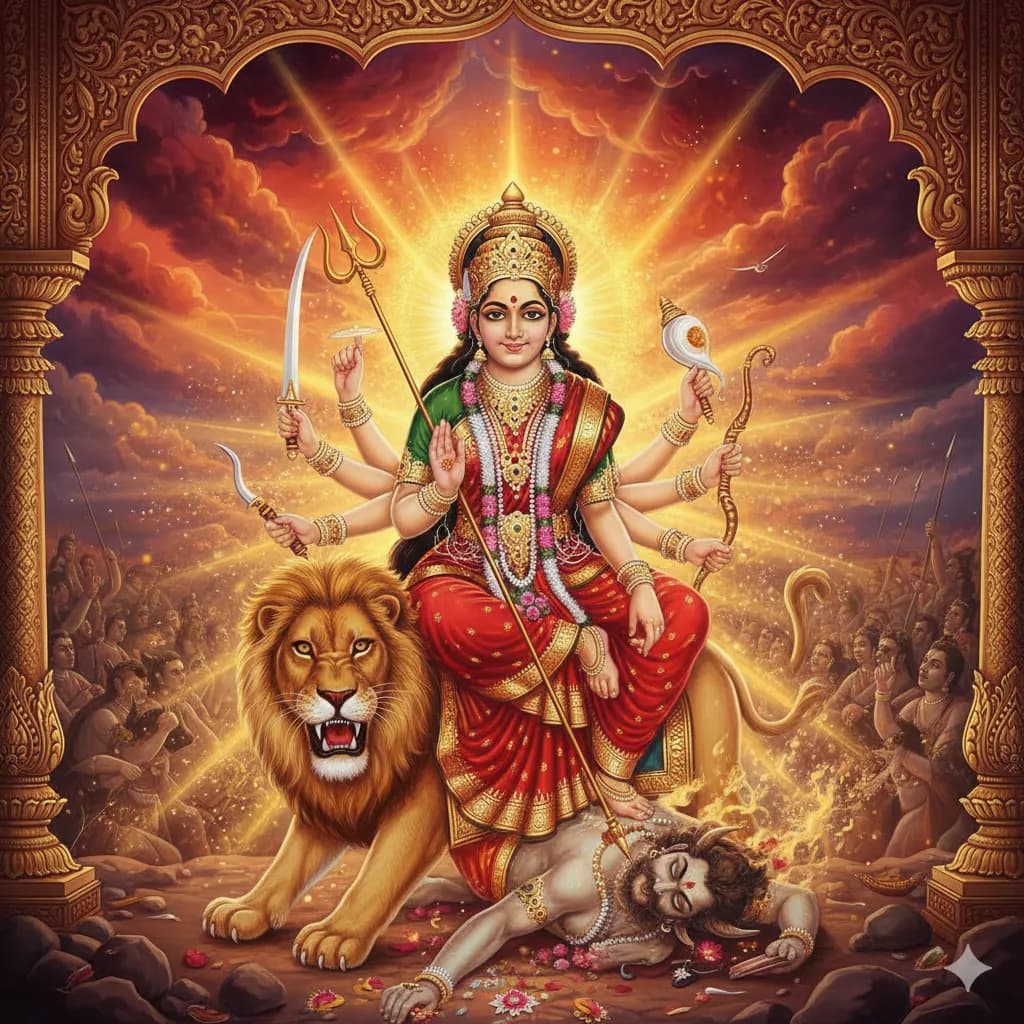
The Great Battle: For nine days and nights, Devi fought Mahishasura's armies. She killed thousands of demons, Chikshura, Chamara, Udagra, and countless others. Finally, on the tenth day (Vijayadashami), she slew Mahishasura himself.
Famous Moment: When Mahishasura, shape-shifting between buffalo and human forms, emerged from the slain buffalo's neck in his true demon form, Devi beheaded him with her sword.
Symbolism:
-
Mahishasura: Ego, pride, rajasic (passionate/egoistic) tendencies
-
Buffalo Form: Density, stupidity, stubbornness
-
Shape-Shifting: Ego's ability to take multiple forms
-
Victory: Destruction of ego and passion
-
Vijayadashami: Victory of consciousness over ego
Form: Mahalakshmi, radiant, golden, astride a lion, with multiple weapons, associated with rajas transformation.
Cultural Impact: This is the most famous episode, celebrated as Durga Puja/Navaratri. The image of Durga killing Mahishasura is iconic.
Uttama Charitra (Final Episode): Mahasaraswati
Chapters 9-13 (300 verses)
The Crisis: Demon brothers Shumbha and Nishumbha, along with their generals Chanda, Munda, and Raktabija, terrorized the three worlds. Even more powerful than Mahishasura.
Devi's Return: The gods again prayed to Devi. She manifested from Parvati's body as Ambika/Chandika.
Kali's Emergence: During battle, when Devi's face darkened with anger, Kali emerged from her forehead, completely black, gaunt, with a lolling tongue, carrying a skull-topped staff and a noose.
Impossible Enemy - Raktabija: Demon general Raktabija had a boon: every drop of his blood that fell to earth would spawn a new demon exactly like him. As Devi killed him repeatedly, millions of Raktabijas emerged.
Kali's Solution: Kali spread her tongue across the battlefield, drinking every drop of blood before it touched ground, while Devi killed the original. Finally, Raktabija died bloodless.
Saptamatrikas: Seven Mother Goddesses emerged from major gods to help Devi battle the demon armies.
Final Battles: Devi killed generals Chanda and Munda (Kali earned the name "Chamunda" for this). Then she killed Nishumbha and finally Shumbha in single combat.
Shumbha's Protest: Before death, Shumbha accused Devi of unfairly using helpers. She responded by absorbing all other goddesses back into Herself, demonstrating She is One despite many forms, then killed him alone.
Symbolism:
-
Shumbha and Nishumbha: Subtle spiritual pride, even sattvic ego
-
Raktabija: Endless reproduction of thoughts/desires from one original thought
-
Kali's Drinking Blood: Mindfulness intercepting thoughts before they manifest
-
Victory: Destruction of even the spiritual ego, final liberation
-
Absorption of All Forms: Non-dual reality, all forms are one Goddess
Form: Mahasaraswati, white, associated with sattva transcendence.
Deepest Teaching: Even spiritual accomplishment can become an obstacle when the ego attaches to it. Devi destroys this final, subtlest form of bondage.
Scriptural Significance
Placement in Markandeya Purana
Frame Story: Sage Markandeya narrates these episodes to console King Suratha and merchant Samadhi, showing that surrender to Devi brings grace beyond human effort.
Their Transformation: After hearing the Mahatmya, both perform tapasya to Devi. She appears and grants them boons. Suratha regains his kingdom, and Samadhi gains spiritual wisdom.
Teaching: Demonstrates that Devi worship brings both material success and spiritual liberation based on the devotee's desire and readiness.
Relation to Other Texts
Devi Bhagavata Purana: Another major Shakta Purana with different Devi stories, but Saptashati remains the most recited.
Lalita Sahasranama: 1000 names of Goddess Lalita, another major Shakta text, complementary to Saptashati.
Soundarya Lahari: Adi Shankaracharya's 100 verses on Goddess beauty and power, a philosophical companion to Saptashati's narratives.
Tantric Connection: Saptashati is a foundational text for many Tantric practices worshipping Devi in various forms.
Structure and Content
The 13 Chapters (Adhyayas)
Chapter 1: Meditation chapter, Mahakali's emergence and setting
Chapters 2-4: First episode (Madhu-Kaitabha destruction)
Chapter 5: Gods' hymn to Devi and Her manifestation
Chapters 6-8: Second episode (Mahishasura battle and defeat)
Chapter 9-10: Third episode begins (Shumbha-Nishumbha armies)
Chapter 11: Killing of Raktabija and great battles
Chapters 12-13: Final battles, Shumbha-Nishumbha's death, the gods' hymns
The Three Hymns (Stutis)
Brahma Stuti (Chapter 1): Brahma's prayer to Yoganidra to awaken Vishnu.
Shakradhi Stuti (Chapter 4): Indra and the gods' hymn after Madhu-Kaitabha's death.
Savarna Stuti (Chapter 5): Gods' hymn requesting Devi's manifestation for the Mahishasura battle.
Devi Suktam (Chapter 11): Devi's own proclamation of Her supremacy.
These hymns are often recited separately for specific boons and considered highly powerful mantras.
The Power of Saptashati Recitation
Traditional Beliefs
- Protection: Creates a protective shield around the devotee from enemies, black magic, evil spirits, accidents, and calamities.
- Obstacle Removal: Destroys blocks in all life areas—career, relationships, health, wealth, spiritual progress.
- Victory: Grants success over competition, enemies, difficult situations, and impossible odds.
- Healing: Traditional belief in powerful healing effects, especially for chronic or serious diseases.
- Wish Fulfillment: Regular recitation is said to fulfill sincere prayers and desires.
- Spiritual Progress: Purifies consciousness, removes karmic obstacles, accelerates spiritual evolution.
How It Works (Traditional Understanding)
- Sound Vibration: Each verse is a mantra. Proper recitation activates dormant spiritual energy.
- Narrative Power: The demon-slaying stories aren't just mythology; they're energy patterns that replay in the devotee's consciousness, destroying their inner demons.
- Devi's Direct Presence: Traditional belief holds that reciting Saptashati invokes Devi's actual presence, not just remembrance.
- Cumulative Effect: Multiple recitations build increasing power, like compound interest in the spiritual realm.
Multiple Recitation Traditions
- Single Path: One complete reading, for general blessings, devotional practice.
- Tripath (3 Times): For specific wishes or moderate obstacles.
- Saptapath (7 Times): For serious problems, number 7 is sacred to Devi.
- Navapath (9 Times): During Navaratri, one recitation per day, complete nine-night observance.
- Shatapath (108 Times): For extreme situations—major health crises, life-threatening dangers, seemingly impossible obstacles. This is an intensive multi-day undertaking.
Navaratri Connection
Nine Nights, Nine Forms
Navaratri celebrates nine forms of Durga:
-
Shailaputri (Mountain's daughter)
-
Brahmacharini (Unmarried ascetic)
-
Chandraghanta (Moon-bell)
-
Kushmanda (Cosmic egg creator)
-
Skandamata (Mother of Skanda/Kartikeya)
-
Katyayani (Daughter of sage Katyayana)
-
Kalaratri (Dark night)
-
Mahagauri (Great fair one)
-
Siddhidatri (Bestower of perfections)
Saptashati During Navaratri
Daily Recitation: One complete Saptashati each of nine nights, completing nine full readings.
Culmination: The tenth day (Vijayadashami) celebrates Devi's victory over Mahishasura.
Most Auspicious: Navaratri is considered a supremely powerful time for Saptashati, Devi's energy at its peak.
Community Practice: Many temples and communities organize continuous Saptashati recitation throughout the nine days.
Regional Variations and Traditions
Bengali Durga Puja
Central Feature: Saptashati recitation integral to five-day Durga Puja celebration.
Sandhi Puja: Special moment when Ashtami ends, and Navami begins—108 lotuses offered during Saptashati verses.
Cultural Identity: Durga Puja and Saptashatiare deeply embedded in Bengali Hindu identity.
Nepali Tradition
Dashain: Nepal's biggest festival, centered on Durga worship and Saptashati recitation.
Taleju Worship: Royal Kumari tradition connected to Durga/Taleju (Nepali name) worship.
Phulpati: Sixth-day ceremony involving sacred plants, during which Saptashati is prominently recited.
South Indian Practice
Navaratri Golu: Doll display tradition during Navaratri, with Saptashati recitation in homes and temples.
Different Emphasis: While North India emphasizes Durga's warrior aspect, South India often emphasizes Lakshmi and Saraswati during Navaratri.
North Indian Tradition
Ram Lila: In some regions, Navaratri concludes with Dussehra, celebrating Rama's victory, though Durga worship is prominent in the early days.
Kanya Puja: Worship of young girls as Devi's manifestation, often following Saptashati recitation.
Philosophical and Symbolic Interpretations
External Level: Demon Slaying
The most straightforward reading, Goddess is destroying actual demons threatening cosmic order. This satisfies devotees seeking divine intervention in worldly problems (enemies, obstacles, dangers).
Internal Level: Psychological
Demons as Mental States:
-
Madhu-Kaitabha: Deep ignorance, fundamental misunderstanding
-
Mahishasura: Ego, pride, stubbornness
-
Raktabija: Endless mental proliferation, obsessive thoughts
-
Shumbha-Nishumbha: Subtle spiritual pride, dualistic thinking
Victory as Self-Transformation: Saptashati becomes a map of spiritual psychology, how consciousness overcomes its own obstacles.
Mystical Level: Kundalini and Chakras
Some Tantric interpretations:
-
Three episodes correspond to three granthis (knots) in the subtle body
-
Demon battles represent kundalini's journey through chakras
-
Devi's weapons symbolize specific spiritual powers awakening
Advaitic Level: Non-Dual Reality
Deepest interpretation:
-
All forms, gods, demons, Devi herself, are one Consciousness
-
Battles represent Consciousness recognizing and reabsorbing its own projections
-
Final absorption of all goddesses into one demonstrates the non-dual truth
-
Liberation comes from recognizing that you are that which Saptashati describes
Modern Relevance
For Women's Empowerment
Divine Feminine Power: In an era questioning traditional gender roles, Saptashati presents a powerful female deity who defeats male demon gods, which couldn't strong feminist resonance.
Independence: Devi needs no male consort to fight. She is complete, independent, and self-sufficient.
Warrior Goddess: Not passive or merely nurturing, actively destroys evil with weapons and strategy.
Facing Modern Challenges
Corporate/Professional "Demons": Competitive colleagues, hostile bosses, unfair systems, modern equivalents of Saptashati's demons.
Psychological Demons: Anxiety, depression, addiction, trauma, internal enemies. Saptashati addresses symbolically.
Structural Evil: Injustice, oppression, corruption, large-scale problems requiring divine intervention beyond individual capacity.
For Diaspora Hindus
Cultural Continuity: Annual Navaratri Saptashati connects diaspora families to Hindu tradition.
Community Building: Durga Puja and Saptashati recitation create a Hindu community in non-Hindu environments.
Accessible Practice: Unlike complex Vedic rituals, listening to Saptashati is accessible, can be done in any language, any location.
Universal Themes: Good vs. evil, protection from danger, mother's love, resonate across cultures.
Controversies and Critiques
Violence and Demon Slaying
The Issue: Graphic violence, beheading, blood-drinking, battlefield descriptions, trouble some modern readers.
Traditional Response: Violence is spiritual, not literal, and represents the forceful removal of stubborn obstacles. Compassion alone doesn't work against certain evils; fierce power is needed.
Feminist Reading: Reclaims female anger and aggression as sacred, not shameful. Devi's violence is righteous, protective, and liberating.
Dualism vs. Advaita
Tension: Saptashati seems dualistic (good vs. evil, Devi vs. demons), but Advaita teaches non-duality.
Resolution: Apparent dualism is pedagogical, meets devotees at their level. Deepest teaching (Shumbha's absorption) points to non-duality.
Both Valid: Dualistic devotion and non-dual wisdom aren't contradictory but progressive stages.
Durga Saptashati stands as Shakta Hinduism's central text, combining gripping narrative, profound philosophy, powerful mantras, and practical efficacy. For over 1,500 years, millions have recited these 700 verses seeking Devi's protection, blessings, and grace.
Whether approached as literal mythology, psychological map, mystical text, or devotional scripture, the Saptashati offers layers of meaning. For NRNs and diaspora Hindus, it provides a connection to tradition, an empowering narrative, and an accessible spiritual practice; just listening to recitation invokes its power.
The ancient hymn's continuing relevance speaks to universal human experiences, facing overwhelming obstacles, needing courage against impossible odds, seeking protection from forces beyond control, and yearning for ultimate victory. In Devi's triumph over Madhu-Kaitabha, Mahishasura, and Shumbha-Nishumbha, devotees see promise that with Mother's grace, they too shall overcome.
Social Share: