Rudraksha Energizing (Pran Pratishtha): Process, Mantras, and Importance
2026-03-13
20.8 min read
Imagine receiving the most powerful medicinal herb in the world, but it is sealed inside its container, its active compounds locked away, unavailable to your body until the seal is broken. An unenergized Rudraksha is similar. The seed carries immense spiritual potential, but without the sacred ritual of Pran Pratishtha, that potential remains largely dormant.
Pran Pratishtha is not a superstition or a ceremonial formality. It is the activation protocol for Rudraksha, a Vedic process rooted in thousands of years of spiritual science that awakens the bead's full spiritual, health, and astrological power and establishes a living bond between the bead, the deity it embodies, and the person who will wear it.
This guide explains everything: what Pran Pratishtha means, why it is essential, the complete step-by-step ritual both at Pashupatinath Temple and at home, the specific mantras used, auspicious timings, and what changes to expect in your experience after wearing an energized versus unenergized bead.
What is Pran Pratishtha?
The term Pran Pratishtha (प्राण प्रतिष्ठा) comes from two Sanskrit words:
-
Pran (प्राण) — life force, vital energy, the animating principle of all living beings
-
Pratishtha (प्रतिष्ठा) — establishment, installation, consecration
Together, Pran Pratishtha means "the establishment of life force," the ritual process of invoking and installing divine consciousness and vital energy into a sacred object, transforming it from a physical thing into a living spiritual instrument.
The same ritual is performed when consecrating a deity idol (murti) in a temple. Just as a murti becomes a living deity through Pran Pratishtha, no longer merely stone or metal, but a vessel of divine presence, a Rudraksha bead through this ritual becomes a living conduit of the deity and planetary energy it represents.
Without Pran Pratishtha: The bead works at the physical and bioelectric level, providing some health benefits through its natural electromagnetic properties, but its spiritual and astrological dimensions remain largely inactive.
With Pran Pratishtha: The bead operates on all three levels simultaneously, physical, energetic, and spiritual, providing the full spectrum of benefits for which Rudraksha is revered.
Why Pran Pratishtha is Non-Negotiable
The Shiva Purana is unambiguous: Rudraksha must be properly consecrated and energized before wearing. Here is why this matters practically:
1. Activates the Deity's Presence
Each Rudraksha mukhi is associated with a specific deity, 5 Mukhi with Kalagni Rudra, 7 Mukhi with Goddess Lakshmi, 8 Mukhi with Lord Ganesha, and so on. Pran Pratishtha formally invokes that deity into the bead, establishing a direct energetic channel between the bead and the divine force it represents. Without this invocation, the bead carries the potential connection but not the active one.
2. Establishes Personal Bond (Samkalpa)
A key component of Pran Pratishtha is Samkalpa, the formal declaration of intent in which the wearer's name, birth star, and purpose for wearing the bead are announced in the presence of the divine. This creates a personalized energetic imprint, the bead becomes specifically attuned to the wearer's energy field and intention.
3. Clears Previous Energetic Imprints
From the moment a Rudraksha seed is harvested, it passes through many hands harvesters, traders, shippers, and handlers. Each person leaves energetic traces on the bead. Pran Pratishtha's purification phase (Shodashopachar, the sixteen services) clears all previous imprints, making the bead energetically clean and ready to bond exclusively with its new wearer.
4. Aligns the Bead with Cosmic Timing
The ritual is performed at auspicious times, specific days, lunar phases, and planetary positions that align the bead's activation with favorable cosmic energies. This timing amplifies the quality of the initial energetic imprint, creating a stronger and more harmonious bond between bead and wearer.
5. Dramatically Accelerates Benefits
Wearers who receive Pashupatinath-energized Rudraksha consistently report experiencing benefits within days to weeks compared to months that unenergized beads may take to produce noticeable effects.
The Significance of Pashupatinath Temple Energizing
While Pran Pratishtha can be performed anywhere by a qualified priest, energizing at Pashupatinath Temple, Kathmandu, is recognized as the most powerful form of Rudraksha consecration in the world for reasons that are both spiritual and uniquely geographical.
Why Pashupatinath is Unparalleled
1. The Principal Seat of Lord Shiva
Pashupatinath is not merely a Shiva temple it is considered one of the four most sacred dhams (abodes) of Lord Shiva, and the primary seat of Pashupatinath Shiva in his role as the supreme lord and protector of all living beings. The divine energy concentrated at this location is immeasurably more potent than at ordinary temples.
2. UNESCO World Heritage Site and Ancient Sacred Vortex
The temple complex, dating back to the 5th century AD and recognized as a UNESCO World Heritage Site, sits at a powerful spiritual vortex on the banks of the sacred Bagmati River itself a tributary of the Ganges. Ancient Vedic science identifies certain geographical locations as natural concentrations of cosmic energy (shakti peeths and jyotirlingas). Pashupatinath is precisely such a location where the earth's energy field is exceptionally concentrated and spiritually potent.
3. The Sacred Shivalinga — Direct Divine Contact
The central Shivalinga of Pashupatinath, adorned with a four-faced (Chaturmukhi) form representing Shiva's omnidirectional presence, is one of the most sacred objects in all of Hinduism. When Rudraksha beads are brought into direct contact with this Shivalinga during the energizing ritual, they absorb its concentrated divine vibration directly.
The Shivalinga is so sacred that only the chief Bhatt priests (a lineage of priests who have served Pashupatinath for generations) may touch it. When your Rudraksha receives energizing through these priests, it has been blessed through a direct lineage of devotion and sacred knowledge stretching back centuries.
4. The Continuous Energy of Ongoing Worship
Pashupatinath Temple has been in continuous worship for over 1,500 years. The cumulative effect of millions of devotees' prayers, daily abhisheks, fire rituals, and mantra chanting has created an extraordinarily dense field of spiritual energy at this location energy that is absorbed by Rudraksha beads during energizing.
5. Nepal as the Origin Land
Nepal is not only where the finest Rudraksha beads grow, but it is also the land most intimately connected with Lord Shiva's own mythology and presence. The Himalayas are considered Shiva's abode (Kailash), and Nepal's sacred geography makes it the most appropriate place for Rudraksha consecration. A Nepal-origin bead energized at Nepal's premier Shiva temple creates the most complete and authentic spiritual alignment possible.
The Complete Pran Pratishtha Ritual at Pashupatinath
At Rudrakx, our energizing process follows the complete Vedic Pran Pratishtha protocol performed by certified Bhatt priests at Pashupatinath Temple. Here is the full sequence:
Phase 1: Purification (Shodhana)
Sankalpa (Sacred Intention Declaration)
The ritual begins with Sankalpa, the priest formally declares the purpose of the ceremony, names the devotee (bead recipient), their birth star (nakshatra), and their spiritual intention for wearing the bead. This creates the personalized imprint that attunes the bead to its specific wearer.
Without Sankalpa, the energized bead carries general divine energy but lacks the personalized attunement. With Sankalpa, the bead becomes a customized spiritual instrument, calibrated to the specific energy field of its wearer.
Swasti Vachan (Auspicious Opening Invocation)
Sacred mantras are chanted, invoking the blessings of Lord Ganesha (remover of obstacles), Goddess Saraswati (wisdom), and the Navagraha (nine planets), requesting their support for the ritual to proceed without obstruction and with complete spiritual effectiveness.
Abhishek with Panchagavya
The bead is ritually bathed (abhishek) with Panchagavya, a sacred mixture of five cow-derived substances:
-
Gomaya (cow dung) — purification
-
Gomutra (cow urine) — detoxification
-
Ksheera (milk) — nourishment
-
Dadhi (curd/yogurt) — cooling energy
-
Ghrita (ghee) — luminosity and strength
This Abhishek clears all previous energetic imprints from the bead, returning it to a state of pure spiritual neutrality, ready to receive fresh divine imprinting.
Abhishek with Panchamrita
A second Abhishek follows with Panchamrita — five sacred liquids:
-
Milk — purity and nourishment of the divine
-
Curd — prosperity and coolness
-
Honey — sweetness and attraction
-
Ghee — spiritual fire and luminosity
-
Sugar/jaggery — auspiciousness and positive energy
Each liquid is offered with specific mantras, progressively raising the bead's energetic frequency.
Ganga Jal Purification
The bead is then bathed in sacred Ganga Jal (Ganges water) at Pashupatinath, water from the Bagmati River (a sacred Ganges tributary flowing directly past the temple) is used. Ganga Jal is considered the most purifying substance in Vedic tradition its touch removes karmic impurities from any object.
Phase 2: Deity Invocation (Avahana)
Kalash Sthapana (Sacred Vessel Establishment)
A copper or brass Kalash (sacred pot) filled with water, mango leaves, and a coconut is established on the altar. The Kalash represents the universal womb of creation, it becomes the vessel into which divine energy is first summoned before being transferred to the Rudraksha.
Ganesh Puja
Lord Ganesha is worshipped first, as the deity who presides over all beginnings and removes all obstacles from sacred rituals. His blessings are essential for any Vedic ceremony to achieve its intended result.
Shiva Puja: Invoking the Source
A complete Shiva Puja is performed at the Shivalinga the central act that connects the ritual to the divine source:
-
Jalabhishek: Continuous pouring of water over the Shivalinga while chanting Rudri (selections from the Rudrashtadhyayi of the Yajurveda)
-
Offerings of Bilva leaves, Dhatura flowers, and Akanda flowers - Shiva's three most sacred offerings
-
Panch Amrit abhishek the Shivalinga is bathed with the five sacred substances
-
Solah Shringar to Goddess Parvati offering of sixteen adornments to Shiva's divine consort
-
Lighting of the sesame oil lamp and dhoop symbolizing the removal of spiritual darkness
Phase 3: The Core Energizing (Pran Pratishtha)
Rudrabhishek Puja
This is the heart of the entire ceremony, the most powerful Vedic ritual for Rudraksha energizing. During Rudrabhishek:
-
The Rudraksha bead is placed at the base of the Shivalinga
-
The priest performs continuous abhishek of the Shivalinga with a sacred mixture of Ganga water, milk, honey, sugarcane juice, and sandalwood water in an unbroken stream
-
Simultaneously, the priest chants Rudri, selections from the Shri Rudram and Chamakam of the Yajurveda, specifically the eleven hymns (Ekadashi Rudri) that represent the eleven forms of Rudra/Shiva
-
The bead absorbs the combined energy of the Shivalinga, the sacred liquids, and the Vedic mantras throughout this process
Beej Mantra Japa: 108 Times
Following Rudrabhishek, the priest focuses exclusively on the Rudraksha bead and chants its specific beej mantra (seed mantra) a minimum of 108 times:
-
The priest holds the bead in the right hand
-
Eyes are closed, focusing entirely on the bead
-
The beej mantra for the specific mukhi is chanted with complete concentration — each repetition driving the mantra's vibrational code deeper into the bead's energetic structure
-
Additional Shiva mantras, including "Om Namah Shivaya", the Mahamrityunjaya mantra, and the Rudra Gayatri, are chanted to complete the divine infusion
Prana Sparsha (Touch Energizing at the Shivalinga)
In the final activation step, unique to Pashupatinath Temple, the Rudraksha bead is physically touched to the sacred Shivalinga by the chief Bhatt priest. This direct contact with the Shivalinga transfers a charge of Pashupatinath's concentrated divine energy directly into the bead.
This step, Prana Sparsha, is what makes Pashupatinath categorically more powerful than energizing performed elsewhere. The direct touch of the Shivalinga at this specific sacred vortex, performed by a priest from the ancient Bhatt lineage, creates an energetic imprint of extraordinary quality and intensity.
Phase 4: Completion (Samarpan)
Aarti and Prasad
The ritual concludes with Shiva Aarti, the sacred waving of lights before the deity symbolizing the offering of everything back to Shiva, and the receipt of his blessings in return. The bead is then presented as prasad a blessed offering having been fully consecrated and energized.
Samkalpa Completion
The priest formally announces the completion of the Samkalpa, the energizing has been performed for the named devotee, for their stated purpose, and the bead is now prepared for that person's use.
Home Energizing Ritual: For Beads Not Yet Energized
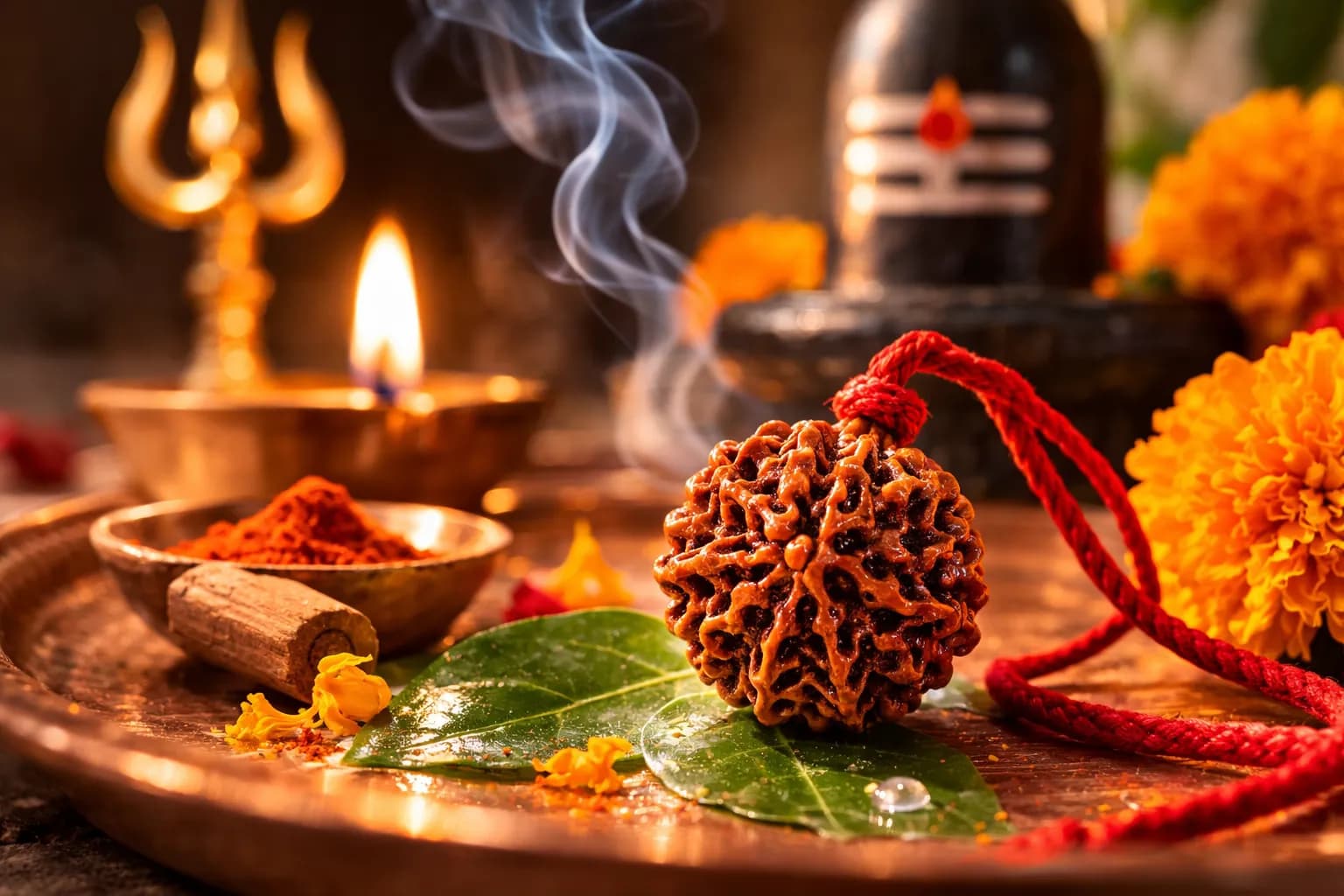
If you have a Rudraksha that has not been professionally energized, you can perform a simplified home energizing ritual. While this does not match the power of Pashupatinath Temple energizing, it is a meaningful and effective activation for daily use.
What You Need:
-
Rudraksha bead
-
Copper or brass plate
-
Ganga jal or clean water
-
Milk, honey, ghee
-
Bilva (Bael) leaves 3 or 5 (available at most puja shops)
-
Sandalwood paste
-
Incense sticks (preferably sandalwood or dhoop)
-
Ghee lamp (diya)
-
Fresh flowers
Auspicious Day and Time:
-
Best day: Monday (Shiva's day), especially during the Shravan month
-
Best time: Brahma Muhurta (90 minutes before sunrise) or the morning after your bath
-
Most auspicious: Maha Shivaratri, Pradosh Kaal (twilight on Trayodashi, the 13th lunar day), or any Monday during Shravan
Step-by-Step Home Ritual:
-
Purify yourself and space: Take a bath. Cleanse your puja space. Light a ghee lamp and incense sticks
-
Place the bead: Set the Rudraksha on a clean copper plate or silk cloth. Place Bilva leaves beneath it
-
Sankalpa: Hold a little clean water in your right palm, speak your name, your intention, and the purpose for which you are wearing this bead. Pour the water into a bowl as the formal declaration
-
Panchagavya abhishek: If available, bathe the bead with Panchagavya. Otherwise, proceed with Panchamrita
-
Panchamrita abhishek: Pour milk, curd, honey, ghee, and sugar water over the bead in sequence, each with the chanting of "Om Namah Shivaya."
-
Ganga jal bath: Rinse the bead with Ganga jal (or clean water if unavailable), wiping gently with a clean cloth
-
Apply sandalwood: Apply a small mark of sandalwood paste on the top of the bead
-
Offer Bilva leaves and flowers: Place Bilva leaves and flowers around and on the bead as offerings to Lord Shiva
-
Beej mantra japa 108 times: Hold the bead in your right palm, close your eyes, and chant the beej mantra specific to your mukhi 108 times with full focus and devotion. Simultaneously visualize bright white or golden light entering and filling the bead
-
Om Namah Shivaya 108 times: Follow with 108 repetitions of the Mahamantra while continuing to hold the bead
-
Intention setting: With eyes still closed, hold the bead at your heart and mentally state your clear intention, what you are seeking through this Rudraksha
-
Wear with Rudra Gayatri: While placing the bead around your neck or wrist, chant: "Om Tatpurushaaya Vidmahe Mahaadevaaya Dhimahi Tanno Rudrah Prachodayaat" once
Auspicious Times for Rudraksha Energizing
Vedic timing (muhurta) amplifies the quality of Pran Pratishtha. Here are the most auspicious windows:
|
Occasion |
Why Auspicious |
|
Maha Shivaratri |
The holiest night of Shiva, maximum Shiva energy available |
|
Pradosh Kaal (Trayodashi) |
Twilight of the 13th lunar day is Shiva's most sacred time of the lunar cycle |
|
Shravan Mondays |
Every Monday of the Shravan month (July–August), the entire month is sacred to Shiva |
|
Mondays (Somavar) |
The weekly sacred day of Lord Shiva is the most accessible regular auspicious day |
|
Navratri |
Particularly for Mukhis connected to the Goddess (9 Mukhi, Gauri Shankar) |
|
Solar and Lunar Eclipses |
Powerful cosmic alignments that amplify ritual energy, though these are also considered impure by some traditions |
|
Your Birth Star Day |
The monthly return of your natal nakshatra is personally auspicious |
Energized vs. Unenergized Rudraksha: The Difference in Experience
|
Aspect |
Unenergized Rudraksha |
Pashupatinath Energized Rudraksha |
|
Health benefits |
Partial — bioelectric effects only |
Full — bioelectric + pranic + spiritual |
|
Spiritual connection |
Weak — general Shiva energy |
Strong — specific deity directly invoked |
|
Astrological remedy |
Limited — planetary frequency present but not activated |
Full — planetary energy channeled and personalized |
|
Time to feel effects |
Months |
Days to weeks |
|
Personal bond |
Generic |
Personalized through Samkalpa |
|
Protection |
Basic |
Comprehensive — aura shielding active |
|
Meditation enhancement |
Mild |
Significant — deep states accessed faster |
Re-Energizing Your Rudraksha
Rudraksha may need re-energizing in certain situations:
-
After a serious illness of the wearer
-
After the bead has been left unused for more than 6 months
-
If the bead was exposed to significant negative energy environments
-
After the death of a close family member
-
If the bead feels energetically "flat" no warmth or vibration when held
Rudrakx Re-Energizing Service: All Rudrakx customers can send their bead back to us for a complete re-energizing at Pashupatinath Temple, restoring its full power.
Frequently Asked Questions
1: Can Rudraksha energize itself without a ritual?
Genuine Rudraksha naturally carries bioelectric and electromagnetic properties regardless of energizing; these produce measurable physical effects from day one. However, the spiritual, astrological, and deeper healing dimensions of the bead are significantly amplified by proper Pran Pratishtha. Think of it as the difference between a mobile phone with no SIM card (working but limited) versus a fully activated phone (complete functionality).
2: How long does Pashupatinath energizing last?
Properly performed Pran Pratishtha creates a permanent energetic imprint, it does not "expire." However, the energy can become diminished over time through exposure to negative environments, illness, or extended disuse. Periodic re-energizing (every 3–5 years, or when needed) refreshes the bead's power.
3: Can I energize Rudraksha myself at home?
Yes, the home ritual described above is valid and meaningful. However, home energizing by a layperson produces a significantly less powerful activation than a full ceremony performed by trained priests at a powerful sacred site. For daily-use 5 Mukhi beads, home energizing is adequate. For high-value or astrological remedy beads, professional energizing at Pashupatinath is strongly recommended.
4: Does Rudrakx energize all beads before shipping?
Yes. Every single bead sold by Rudrakx, regardless of mukhi type or price, is energized at Pashupatinath Temple before shipping. Your bead arrives fully activated and ready to wear from day one. No additional home ritual is required, though you are welcome to perform a personal morning mantra practice to establish your own conscious connection with the bead.
5: What is the difference between energizing at Pashupatinath vs. other temples?
Pashupatinath is Lord Shiva's principal seat in Nepal, the land where the finest Rudraksha beads grow. The direct connection between Nepal-origin Rudraksha, Lord Pashupatinath, and the ancient Bhatt priest lineage creates a uniquely powerful and authentic consecration. Other Shiva temples (Varanasi, Rameshwaram) also offer valid energizing, but for Nepal Rudraksha specifically, Pashupatinath represents the most natural, authentic, and potent alignment.
6: Can a previously worn Rudraksha be energized?
Yes. If you have a Rudraksha that was previously worn by someone else (inherited, gifted second-hand, or purchased used), it should be energized with a new Samkalpa declaring your name and intention. This clears the previous wearer's imprint and establishes your personal bond with the bead.
7: What happens if I accidentally drop my Rudraksha during the ritual?
Do not be alarmed, simply pick it up, place it back on the puja plate, offer a brief apology prayer ("Om Namah Shivaya" three times), and continue the ritual. Accidental drops during ritual are not considered inauspicious; the ritual's power is not broken.
8: Is Pran Pratishtha required for Rudraksha worn purely for health benefits?
Even for those seeking primarily physical health benefits (blood pressure regulation, stress reduction), energizing significantly accelerates and deepens results. The body's response to an energized bead, which carries both bioelectric properties AND an active pranic charge, is measurably stronger than its response to an unenergized bead. Energizing is always recommended regardless of your primary motivation.