How to Identify Original Rudraksha Authenticity Tests & Certification | Rudrakx
2026-03-12
18.1 min read
The Rudraksha market has a serious problem. For every genuine bead sold, dozens of fake, chemically treated, or artificially carved counterfeits flood the market, sold at inflated prices to unsuspecting buyers who believe they are receiving something sacred and powerful.
The hard truth: a fake Rudraksha provides zero spiritual, health, or astrological benefit. Worse, buying a fake means your faith, money, and spiritual intention have been misdirected entirely.
This guide gives you every tool you need to identify genuine Rudraksha from basic home tests to the gold-standard X-ray certification method used by Rudraksha. By the end of this guide, you will never be fooled by a fake Rudraksha again.
Why Fake Rudraksha is So Widespread
Understanding why fakes exist helps you understand why vigilance is essential:
-
Price differential is enormous: An authentic 1 Mukhi Nepal Rudraksha can cost NPR 5,00,000+. A convincing fake costs less than NPR 100 to produce
-
Visual similarity: To an untrained eye, a well-made fake is nearly indistinguishable from a genuine bead
-
Low buyer awareness: Most buyers do not know what to look for
-
Online marketplace proliferation: Unverified sellers on Amazon, Flipkart, and local markets sell millions of fake beads annually
-
Artificial carving is easy: Craftsmen can carve lines into seeds of similar appearance (berry seeds, wooden beads) to simulate mukhi lines
Common fake Rudraksha types in the market:
-
Berries of other Elaeocarpus species (not E. ganitrus) similar appearance, zero spiritual value
-
Carved wooden beads completely artificial mukhi lines carved by machine
-
Chemically treated genuine beads real Rudraksha with artificial mukhis carved and stained to look like a higher, rarer mukhi count
-
Joined beads passed as Gauri Shankar two beads glued or wired together, sold as naturally joined Gauri Shankar
-
Indonesian beads sold as Nepal origin genuine Rudraksha, but misrepresented in terms of origin and potency
The Only Foolproof Method: X-Ray Certification
Before covering home tests, it is critical to establish this fact: the only method that provides 100% certainty of Rudraksha authenticity is X-ray imaging.
Here is why:
How X-Ray Authentication Works
Inside every genuine Rudraksha bead are natural internal chambers, hollow compartments that form during the seed's development inside the Elaeocarpus ganitrus fruit.
The number of these internal chambers exactly corresponds to the number of external mukhi lines on the surface.
When a bead is X-rayed:
-
Genuine bead: Internal chambers visible, count matches external mukhis exactly
-
Carved fake: Internal chambers are absent or do not match the external mukhi count
-
Glued Gauri Shankar: Artificial joining visible in the X-ray image
-
Chemically altered bead: Internal structure inconsistent with claimed mukhi count
This internal chamber structure cannot be artificially created it is a product of the seed's natural biological development. No carving, chemical treatment, or artificial process can replicate it. This is why X-ray certification is the gold standard.
What an Authentic X-Ray Certificate Contains
A genuine Rudraksha X-ray certificate should include:
-
Clear X-ray image of the bead showing internal chambers
-
Chamber count matches the external mukhi number
-
Lab name, certification number, and date of testing
-
Signature of the certifying authority
-
Bead dimensions (size in mm)
-
Origin declaration (Nepal/Indonesian)
At Rudrakx, every single bead, regardless of mukhi type or price, is X-ray certified before listing. The certificate accompanies the bead upon delivery.
Home Tests for Rudraksha Authenticity
While X-ray certification is definitive, several home tests provide useful preliminary verification. Important: these tests can suggest authenticity, but cannot rule out sophisticated fakes. Always rely on X-ray certification for high-value beads (8 mukhi and above).
Test 1: The Water Submersion Test (Float vs. Sink)
This is the most widely cited home test for Rudraksha authenticity.
Method:
Fill a glass with clean water at room temperature. Gently place the Rudraksha bead into the water and observe whether it sinks or floats
Interpretation:
-
Genuine Rudraksha: Sinks to the bottom (dense, heavy seed)
-
Fake (hollow or wooden): Floats on the surface
Limitations:
This test is unreliable as a standalone test. Some genuine lightweight Rudraksha beads (particularly smaller Indonesian ones) may float, while some cleverly weighted fakes may sink. Use this test only as a first screening, not as a final verdict.
Test 2: The Copper Coin Test
A traditional test passed down through generations of Rudraksha collectors.
Method:
Place the Rudraksha bead between two copper coins (or hold it between two copper plates). Apply light pressure from both sides and observe whether the bead rotates on its own
Interpretation:
-
Genuine Rudraksha: The bead will slowly rotate or vibrate between the copper coins due to its natural electromagnetic and paramagnetic properties
-
Fake Rudraksha: No movement or rotation observed
Limitations:
This test is difficult to perform consistently, and results vary based on the size and weight of the bead. It works best for larger Nepal-origin beads. Consider it a supplementary test rather than a primary one.
Test 3: Visual Inspection Mukhi Lines
One of the most accessible and informative tests requires only careful naked eye observation (or a magnifying glass for smaller beads).
What to look for in a genuine Rudraksha:
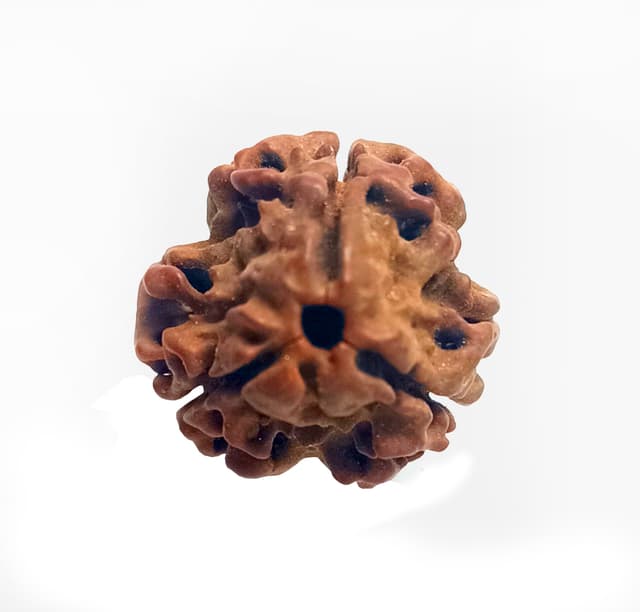
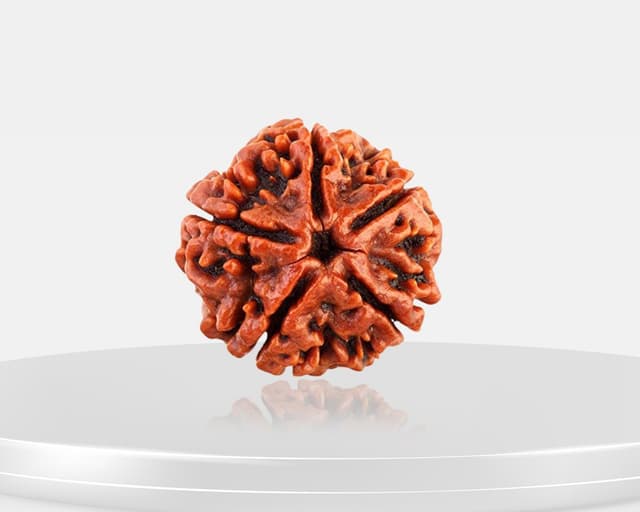
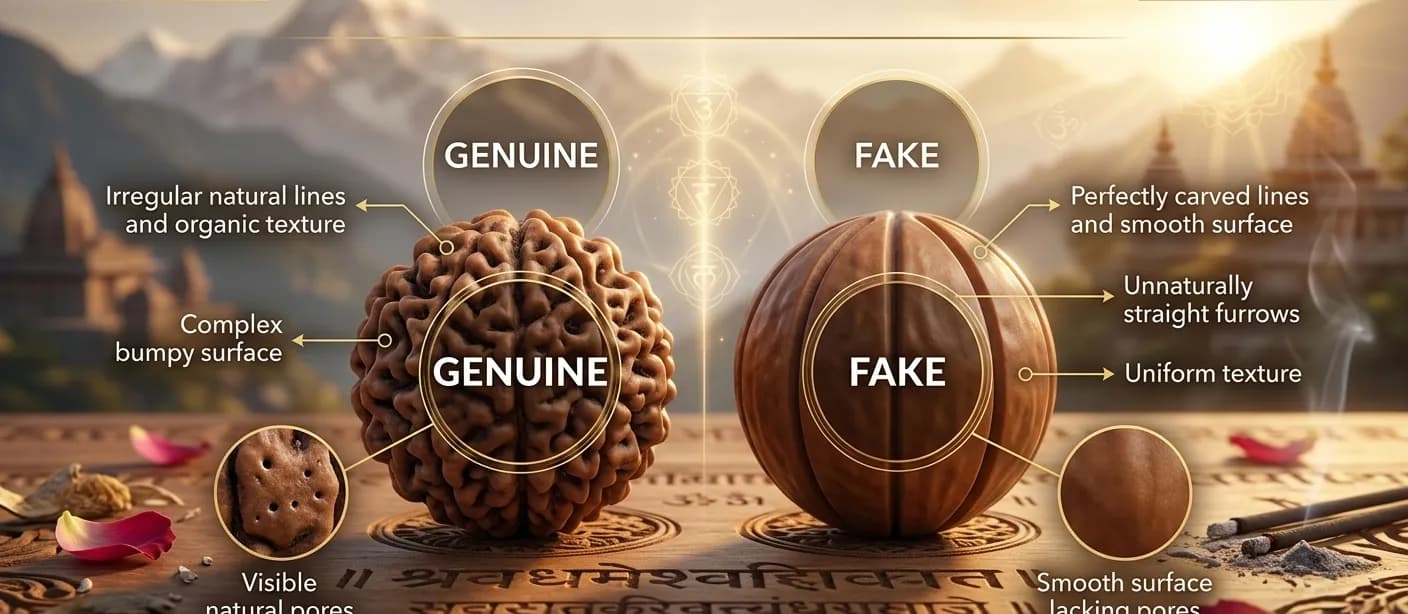
Natural, irregular mukhi lines: Genuine lines are slightly uneven, have natural variation in depth and width, and run continuously from the top (stalk) to the bottom of the bead. They were formed by natural growth, not cut by a machine
Textured surface: Genuine Rudraksha has a naturally rough, organic surface texture with the pores, ridges, and natural imperfections of a real seed
Natural color variation: Genuine beads range from light brown to dark brown/black, with natural variations across the surface, not a uniform painted color
Visible natural pores: Look for tiny natural pores scattered across the bead's surface between the mukhi lines. These are characteristics of genuine Elaeocarpus ganitrus seeds
Organic shape: Genuine Rudraksha is never perfectly round or perfectly symmetrical; it has the natural variation of a living seed
What fake Rudraksha looks like:
Perfectly carved, machine-straight mukhi lines: Artificial lines are evenly spaced, uniform in depth, and appear "cut" rather than "grown" they look too perfect
Smooth, plastic-like surface: Fakes made from other seeds or wood often have an unnaturally smooth surface, or a surface coated with varnish/lacquer
Uniform color: Artificially dyed beads have a suspiciously uniform color with no natural variation
Perfect spherical shape: Natural Rudraksha is never perfectly round if a bead is a perfect sphere, it has almost certainly been artificially shaped
Test 4: The Microscope / Magnification Test
For those with access to a jeweler's loupe or smartphone macro lens, this test reveals details invisible to the naked eye.
What genuine Rudraksha shows under magnification:
-
Natural wood-grain-like texture within each mukhi line
-
Tiny natural pores and surface irregularities are scattered across the surface
-
The mukhi lines show gradual depth variation, deeper in the center, shallower at the edges
-
Natural cracks or minor surface imperfections consistent with an organic seed
What fakes show under magnification:
-
Machine-cut lines with clean, uniform edges, no natural variation
-
Smooth, non-porous surface coating (lacquer, wax, or paint)
-
Artificial pores punched in by tools to simulate genuine texture
-
Stalk hole shows artificial drilling marks rather than a natural fibrous interior
Test 5: The Heat / Flame Test
A more aggressive test is appropriate for suspected fakes.
Method:
Hold the suspected bead near (not in) a flame for 3–5 seconds.
Interpretation:
-
Genuine Rudraksha: No significant change in appearance, no smell (the seed is dense and non-reactive at this level of heat)
-
Plastic or resin fake: May soften, bubble, or emit a distinct chemical smell
-
Painted/varnished bead: Surface coating may bubble or darken noticeably
-
Wooden carved bead: May char or smell of burning wood
Caution: Do not perform this test on a bead you intend to keep wearing, as even genuine Rudraksha may be superficially affected. Use only on beads you are willing to potentially damage.
Test 6: The Weight and Density Check
Genuine Nepal Rudraksha beads have a characteristic weight and density due to their thick, dense seed wall.
What to check:
-
A genuine Nepal Rudraksha of medium size (18–22mm) should feel noticeably heavy for its size, denser than you might expect from a seed
-
If a bead feels surprisingly light or hollow when tapped (tap it gently against a hard surface a genuine bead produces a solid "thud" rather than a hollow "click"), it is likely fake
-
Compare the weight across multiple similar-sized beads of the same mukhi if one feels significantly lighter, investigate further
Test 7: The Scratch Test
Method:
Use a sharp needle or pin to gently scratch an inconspicuous area of the bead's surface.
Interpretation:
-
Genuine Rudraksha: Scratches show natural fibrous wood-like material beneath the surface, consistent with a dense seed
-
Plastic or resin fake: Scratch reveals smooth plastic material with no fibrous texture
-
Painted wooden bead: Scratch may flake off paint or lacquer coating, revealing plain wood beneath
How Rudraksha Fakes are Made?
Understanding the techniques used to create fakes helps you spot them more easily:
Technique 1: Artificial Carving of Higher Mukhis
The most common fraud in the high-value segment. A genuine 5 Mukhi (worth NPR 200–500) is carved to add extra mukhi lines, transforming it into an apparent 10 or 12 Mukhi (worth NPR 5,000–50,000+). The extra lines are carved, then stained with chemicals to blend with the original surface.
How to detect: Under magnification, the original natural lines differ in texture and depth from the added artificial ones. X-ray will show internal chambers matching only the original 5 Mukhis, not the carved ones.
Technique 2: Berberis or Other Berry Seeds
Seeds of the Berberis plant and other similar-looking species are sometimes sold as Rudraksha. These have naturally occurring lines that superficially resemble Mukhi lines.
How to detect: Berberis seeds are significantly lighter than Rudraksha. Under magnification, they lack Rudraksha's characteristic pore pattern. An X-ray will show a completely different internal structure.
Technique 3: Glued Gauri Shankar Fakes
Two common 5 Mukhi beads are glued or wired together at the stalk end and sold as rare, naturally joined Gauri Shankar (genuine value: NPR 5,000–50,000+).
How to detect: Examine the joining area under magnification. Natural Gauri Shankar shows a seamless, organic joint where the two beads grew together. A glued fake shows a seam, adhesive residue, or artificial wire. X-ray clearly shows the absence of a natural internal joining structure.
Technique 4: Indonesian Beads Sold as Nepal Origin
Genuine Rudraksha, but misrepresented as Nepal-origin to justify a higher price.
How to detect: Nepal Rudraksha is significantly larger (typically 18–35mm for medium grade), has deeper and more defined mukhi lines, and is rounder in shape. Indonesian beads are smaller, more oval, and have shallower lines. Size and provenance certification from a trusted source is the best protection.
Red Flags When Buying Rudraksha
Watch for these warning signs when purchasing from any seller:
No X-ray certificate offered: for any bead above 7 Mukhi, this is non-negotiable
Prices that seem too good: a genuine Nepal 1 Mukhi at NPR 5,000 is 100% fake; know the market price before buying
"Free energizing" with no explanation: legitimate energizing at Pashupatinath is a ceremony with real cost; sellers offering it for free are likely misrepresenting
No return or authenticity guarantee: genuine sellers stand behind their product
Beads that are perfectly round and uniform: natural Rudraksha is never perfect
Suspiciously clean, uniform surface: genuine beads have natural imperfections
Sellers who cannot explain their sourcing: where did the bead come from? Which region of Nepal? Can they provide provenance documentation?
The Rudrakx Authenticity Guarantee: Our Complete Process
At Rudrakx, we have built our entire business model on one non-negotiable principle: every bead we sell is 100% authentic, or we refund you completely.
Here is our complete authentication process for every bead:
Step 1: Sourcing
All beads are sourced directly from our trusted network of collectors and forest harvesters in Nepal's eastern Himalayan belt, primarily from Dhahran, Bhojpur, and Dhankuta regions, where the finest E. ganitrus trees grow.
Step 2: Initial Physical Inspection
Every incoming bead undergoes manual inspection for:
-
Natural mukhi line consistency
-
Surface texture and pore pattern
-
Weight and density check
-
Shape and proportion verification
Step 3: X-Ray Certification
Every bead, without exception, is X-rayed at a certified laboratory in Kathmandu. The X-ray image is reviewed by a qualified examiner to verify:
-
Internal chamber count matches external mukhi count
-
No artificial carving or chemical alteration visible
-
Natural internal structure consistent with E. ganitrus
Step 4: Lab Report
Each certified bead receives an official lab report with the X-ray image, chamber count, dimensions, and certifying authority signature.
Step 5: Pashupatinath Energizing
Certified beads are sent to Pashupatinath Temple for Pran Pratishtha energizing by certified priests through Vedic rituals and mantra chanting.
Step 6: Delivery with Documentation
Your bead arrives with its complete documentation: X-ray certificate, lab report, energizing confirmation, and care instructions.
Summary — Authenticity Test Reliability Chart
|
Test Method |
Reliability |
Best For |
Limitations |
|
X-Ray Certification |
✅ 100% Definitive |
All beads, especially rare/high-value |
Requires lab access (Rudrakx provides this) |
|
Visual Inspection |
✅ High (with practice) |
Screening all beads |
Requires a trained eye; sophisticated fakes can fool beginners |
|
Magnification Test |
✅ High |
Spotting carved lines and fake texture |
Requires a loupe or macro lens |
|
Water Float Test |
⚠️ Moderate |
Quick initial screening |
Lightweight genuine beads may float; weighted fakes may sink |
|
Copper Coin Test |
⚠️ Moderate |
Larger Nepal-origin beads |
Inconsistent results; difficult to perform correctly |
|
Weight/Density Check |
⚠️ Moderate |
Detecting hollow or wooden fakes |
Requires experience with genuine beads for comparison |
|
Scratch Test |
⚠️ Moderate |
Detecting plastic/resin fakes |
May damage the genuine bead surface |
|
Heat/Flame Test |
⚠️ Low-Moderate |
Detecting plastic/lacquer fakes |
Risk of damaging genuine beads |
Bottom line: Use visual inspection and the water test as quick preliminary screens. For any bead of value, particularly 8 Mukhi and above, X-ray certification is the only acceptable standard.
Frequently Asked Questions
1: Can fake Rudraksha cause harm?
A fake Rudraksha causes no active harm it simply provides no benefit. The danger is in wasted money, misplaced spiritual investment, and missed opportunity to receive the genuine benefits of a real bead. For high-value purchases, the financial loss can also be significant.
2: Is the water test reliable?
The water test (sink vs. float) is a useful quick screen, but is not reliable as a standalone test. Dense genuine beads sink, but some light genuine beads (particularly small Indonesian ones) may float. Never rely on this test alone for high-value beads.
3: Can I get my existing Rudraksha X-ray tested?
Yes. If you already own Rudraksha and want to verify authenticity, you can get it X-ray tested at gemological laboratories or Rudraksha testing centers in Kathmandu, Delhi, or Mumbai. Rudrakx can assist Nepal-based customers with testing. Contact us for guidance.
4: Does Pashupatinath energizing prove a bead is genuine?
No. Energizing confirms the spiritual activation of the bead but does not verify its physical authenticity. An energized fake is still a fake. Authenticity must be established through X-ray certification before or alongside energizing. At Rudrakx, we certify before energizing, so both are guaranteed.
5: Is the Indonesian Rudraksha fake?
No, Indonesian Rudraksha is genuine Rudraksha from the Elaeocarpus ganitrus tree grown in Java. It is authentic but different from Nepal-origin beads in size, potency, and mukhi definition. It becomes "fake" only when sold as Nepal-origin at Nepal-origin prices. Honest sellers clearly declare the origin.
6: How can I identify genuine Gauri Shankar Rudraksha?
Genuine Gauri Shankar shows a seamless organic joint; the two beads grew together naturally and share continuous mukhi lines across the joining area. X-ray reveals a natural internal structure at the joint. Fakes show a seam, adhesive, or wire at the joint, and the internal structure is discontinuous.
7: What is the most common type of fake sold online?
The most common online fraud is selling carved or artificially enhanced beads, taking genuine lower-mukhi Rudraksha (like 5 Mukhi, costing a few hundred rupees), and carving additional lines to make it appear as a high-value 10, 12, or 14 Mukhi. X-ray testing immediately exposes this fraud as the internal chamber count does not match the claimed Mukhi number.
8: Does the color of Rudraksha indicate authenticity?
Not reliably. Genuine Rudraksha naturally ranges from light honey-brown (freshly harvested) to deep brown/black (aged or treated with oil). A very uniform, painted-looking color can be a red flag for a fake, but many genuine beads are also uniformly colored. Color alone is not a reliable indicator look at texture, weight, and mukhi line character instead.