Nepal vs Indonesia Rudraksha: Key Differences, Identification & Buying Guide
2026-03-19
18.9 min read
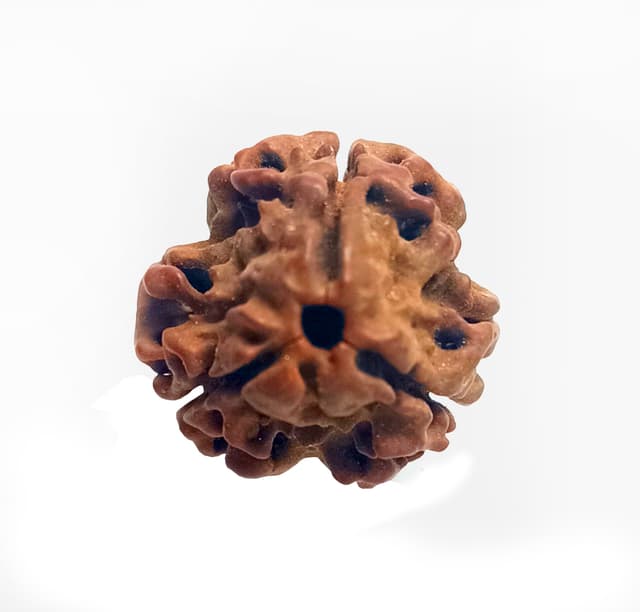
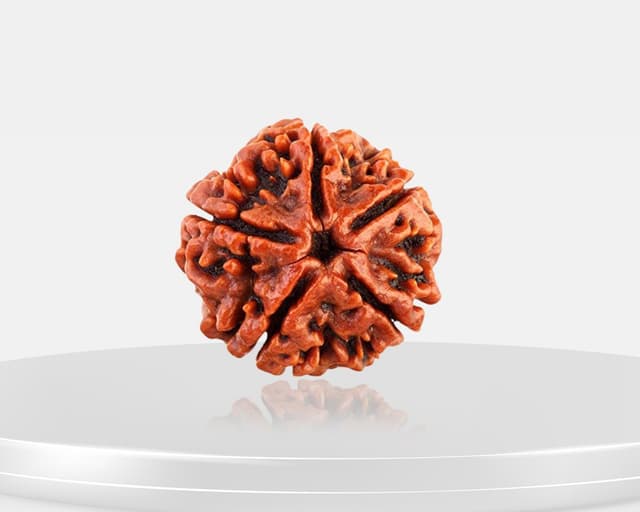
Rudraksha beads hold immense spiritual significance in Hindu and Buddhist traditions, but not all Rudraksha beads are created equal. The two primary sources, Nepal and Indonesia (Java), produce beads with distinct characteristics that affect their quality, effectiveness, and price. Understanding these differences is crucial for making an informed purchase decision.
Where Does Each Rudraksha Come From?
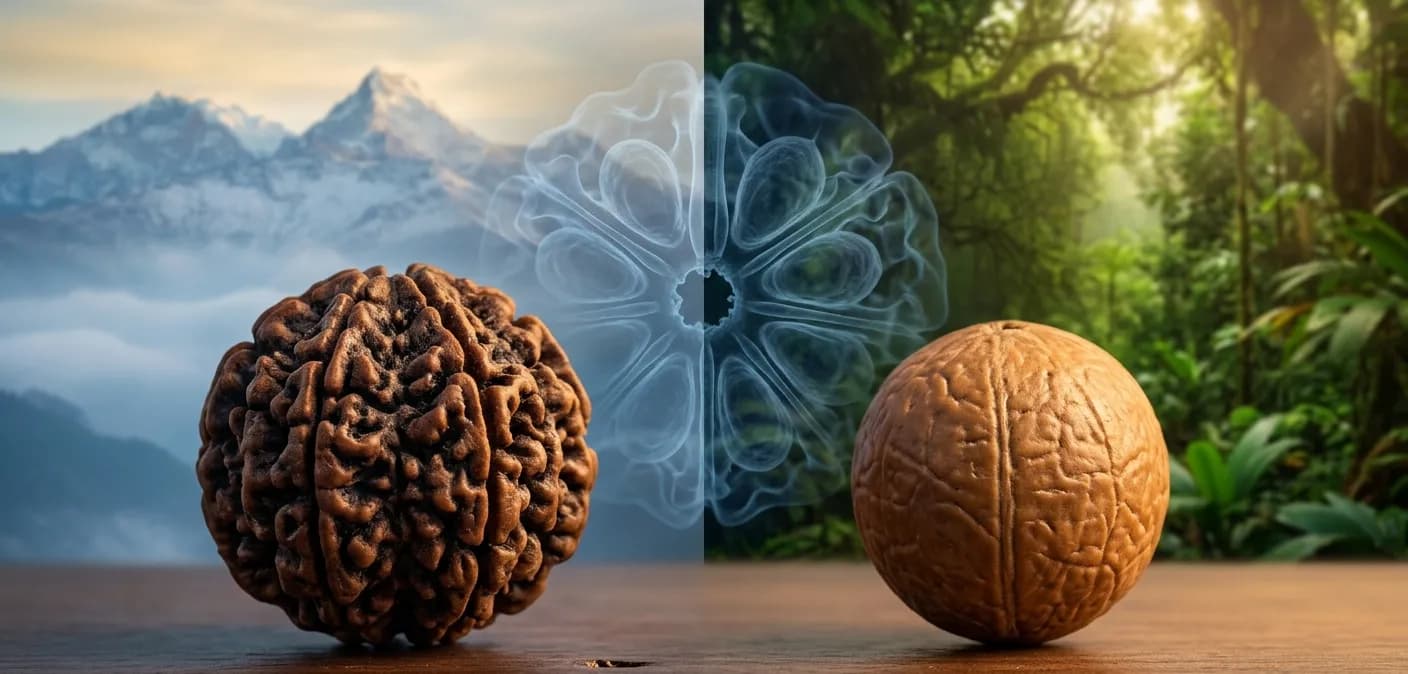
Both Nepalese and Indonesian Rudraksha come from the same tree species, Elaeocarpus ganitrus, but are grown in very different environments. Much like the same grape variety produces different wines depending on terroir (soil, climate, altitude), these environmental differences result in distinct characteristics in the beads.
Nepal Rudraksha: The Himalayan Origin
Nepal Rudraksha grows in the Himalayan foothills at 900 to 3,500 metres, in regions like Makwanpur, Sindhupalchok, and Dolakha. The trees grow in mineral-rich soil under extreme climate conditions.
This slow growth, taking 15 to 20 years, produces beads that are larger, heavier, and have deep, well-defined mukhi lines. Nepal is also home to the sacred Pashupatinath Temple, linking these beads closely to their spiritual origin.
Indonesia (Java) Rudraksha: The Tropical Origin
Indonesian Rudraksha grows mainly in Java, as well as parts of Sumatra and Bali, at elevations below 1,000 metres. The tropical climate is warm, humid, and consistent, with fertile volcanic soil.
These conditions allow faster growth, with trees producing seeds in 8 to 12 years. As a result, the beads are smaller, lighter, and have finer mukhi lines, though they are still genuine Rudraksha from the same species.
Today, Java produces most of the world’s Rudraksha supply, making these beads widely available and more affordable.
Nepal vs Indonesia Rudraksha: The Complete Comparison
The table below presents a detailed, category-by-category comparison across every dimension that matters to a buyer.
|
|
NEPAL RUDRAKSHA |
INDONESIA (JAVA) RUDRAKSHA |
|
Origin |
Himalayan foothills of Nepal — 900 to 3,500 m elevation. Glacially-fed, mineral-rich, alkaline soil. |
Island of Java (Indonesia) — below 1,000 m elevation. Tropical volcanic loam, warm and humid climate. |
|
Tree Growth Time |
15 to 20 years to maturity. Slow, stressed growth under extreme altitude and cold. |
8 to 12 years to maturity. Fast growth in mild, consistently warm tropical climate. |
|
Bead Size |
Large, typically 15 mm to 40 mm in diameter. Some rare specimens reach 45+ mm. |
Small to medium, typically 5 mm to 12 mm. Rarely exceeds 14 mm naturally. |
|
Weight & Density |
Noticeably heavy and dense for its size. Feels solid and substantial in the palm. |
Lighter in comparison. May feel hollow or insubstantial compared to a Nepal bead of similar Mukhi. |
|
Mukhi Line Definition |
Deep, bold, naturally prominent grooves. Lines are clearly visible to the naked eye. Natural irregularities present. |
Finer, shallower grooves. Often require close inspection or magnification to count clearly. More uniform in appearance. |
|
Surface Texture |
Rough, organic, natural. Numerous small protrusions (tubercles) between Mukhi lines. Tactile and distinctive. |
Smoother overall surface. Fewer and smaller tubercles. Often processed or polished for cosmetic appeal. |
|
Natural Colour |
Dark reddish-brown to rich chocolate brown. Deepens further with wear and oiling. |
Lighter brown or tan. Does not darken as dramatically with wear. Some batches are chemically dyed. |
|
Mukhi Range Available |
All Mukhis from 1 to 21 are naturally available, including extremely rare variants (Gauri Shankar, Sawar, Trijuti). |
Primarily 1 Mukhi (crescent-shaped variety), and 2 through 14 Mukhi in standard form. Rarer Mukhi are uncommon. |
|
Energetic Potency |
Considered supreme by the Vedic scriptures. The Shiva Purana specifically praises the Himalayan Rudraksha above all others. |
Accepted as genuine and spiritually valid, but Vedic texts consistently rank it below Himalayan-origin beads. |
|
Scientific Properties |
Studies indicate stronger paramagnetic and bioelectric properties due to mineral-dense high-altitude soil composition. |
Properties present but typically measured as weaker. Lower mineral density in growing soil is a contributing factor. |
|
X-Ray Verification |
Easier to certify due to the large size. Internal chambers (one per Mukhi) are clearly visible in X-ray imaging. |
Requires precision X-ray equipment due to the smaller size. Internal structure is real but more difficult to image clearly. |
|
Price Range |
Higher. Scarcity, slow growth, and spiritual premium drive cost. 5 Mukhi starts at NPR 200–500; rare Mukhis reach lakhs. |
Significantly lower. Abundance and fast production make Java beads widely affordable for all budgets. |
|
Market Authenticity Risk |
High risk of mislabelling, Java beads are frequently sold as 'Nepali' at inflated prices by unscrupulous sellers. |
Lower mislabelling risk (sold as-is), but significant risk of non-Rudraksha fakes (plastic, wood, resin). |
|
Best Suited For |
Serious spiritual practitioners, mala use, pendant use, astrological prescription, collectors, gift-giving. |
Beginners, budget-conscious buyers, bracelet use, children, and everyday casual wear. |
|
Spiritual Certification |
Energized at Pashupatinath Temple (the world's foremost Shiva temple) when purchased through Rudrakx. |
Energized at local temples. The level of sanctity depends entirely on the seller's practices. |
The Five Biggest Differences
The table above gives you the overview. Now, let us go deeper into the five differences that matter most to buyers, the ones that should directly influence your purchasing decision.
1. Size and Weight
This is the most noticeable difference between Nepal and Indonesia Rudraksha. A 5 Mukhi Nepal bead typically measures 18 to 28 mm, while a Java bead of the same type is usually 7 to 10 mm.
Nepal beads feel large and heavy in the hand, whereas Java beads are much smaller and lighter. For example, a 20 mm Nepal bead may weigh 5 to 8 grams, while a similar Java bead weighs around 0.8 to 1.5 grams.
Vedic texts like the Devi Bhagavatam recommend beads around 18 to 22 mm (Amla size) for maximum benefit. By this standard, Nepal beads align more closely with scriptural ideals, while Java beads are considered smaller than ideal.
2. Mukhi Line Depth and Clarity
Mukhi lines are the defining feature of Rudraksha, determining both its type and authenticity. This is where Nepal and Indonesia beads differ significantly.
Nepal Rudraksha has deep, bold lines (around 2 to 4 mm) that are clearly visible and easy to feel. They appear natural and slightly irregular, with rich surface texture.
Java Rudraksha has finer, shallower lines (around 0.5 to 1 mm), often requiring close inspection or angled light to see clearly. Because of this, Java beads are easier to manipulate or carve, making visual identification less reliable. This is why X-ray certification is essential for verifying authenticity.
3. Scriptural and Energetic Standing
Both Nepal and Java Rudraksha are genuine and accepted in the Hindu tradition. A Java bead is not fake or spiritually inactive.
However, Vedic scriptures like the Shiva Purana and Padma Purana consistently regard Himalayan Rudraksha as the most powerful. Beads from the mountains are described as the highest in spiritual potency. From a scientific perspective, studies suggest Nepal beads have stronger bioelectric and paramagnetic properties due to mineral-rich Himalayan soil. Whether viewed spiritually or scientifically, the Himalayan-origin Rudraksha is considered more potent.
4. Surface Texture and Natural Character
Nepal Rudraksha has a rough, organic surface with visible natural protrusions (tubercles), making each bead unique. This irregular texture is a sign of genuine, slow natural formation.
Java Rudraksha, on the other hand, has a smoother and more uniform surface, with less pronounced texture. While it may look more polished, it lacks the raw, natural feel of Nepal beads.
This smoother surface also makes Java beads easier to chemically treat or dye, allowing sellers to make them appear darker and more premium. These coatings often wear off over time.
5. Long-Term Colour Development
Nepal Rudraksha naturally darkens over time. Starting as medium brown, it gradually deepens into a rich, dark shade with regular wear and oiling. This natural change is known as seasoning.
Java beads may darken slightly, but the change is less noticeable. If a bead becomes lighter over time, it is likely chemically treated, as coatings wear off.
A genuine bead darkens with use, not the other way around.
How to Identify Nepal vs Indonesia Rudraksha: The Complete Test Guide
Whether you already own a Rudraksha or are evaluating one before purchase, these tests can help determine its origin with high confidence. No single test is fully reliable on its own, so use multiple tests together for the best results.
1. Size Measurement (Most Reliable First Step)
Measure the diameter of your bead with a ruler or digital calliper (available for under Rs. 300 online). Apply this guideline:
|
Diameter |
Likely Origin |
Confidence |
|
20 mm and above |
Almost certainly Nepal |
Very High |
|
15 mm to 19 mm |
Probably Nepal, possibly Nepal-Java hybrid |
High |
|
12 mm to 14 mm |
Could be either origin — further testing needed |
Medium |
|
Below 12 mm |
Almost certainly Java/Indonesia |
Very High |
|
Below 8 mm |
Java, or possibly non-genuine |
Very High |
2. Mukhi Line Depth Inspection
Examine your bead under a magnifying glass or smartphone camera macro mode in good lighting. Hold the bead so light strikes it at an angle, this will make the Mukhi lines cast shadows and appear more clearly.
◆ Nepal indicator: Lines are deep enough that you can see distinct shadow inside them when light strikes at an angle. You can feel the lines clearly by running a fingernail across the surface.
◆ Java indicator: Lines are finer and shallower. In direct flat light, they may be difficult to distinguish. You need magnification or an angled light to count them clearly.
◆ Fake indicator: Lines are too perfectly uniform, too symmetrical, or appear to be carved into an otherwise smooth surface. Genuine Mukhi lines always have small natural variation and slight irregularity.
3. Surface Tubercle Check
Hold the bead between your thumb and forefinger and slowly roll it while feeling the surface texture. Between the Mukhi lines, look for and feel for small natural protrusions, bumps, ridges, and slight pitting.
◆ Nepal indicator: Numerous prominent tubercles, clear natural roughness, complex, varied texture between lines. The bead has almost a 'coral-like' quality under close inspection.
◆ Java indicator: Fewer, smaller tubercles. Smoother surface between lines. Still present, but more subtle.
◆ Fake/treated indicator: Absolutely smooth surface between lines, or surface has a uniform coating feel. Under magnification, the surface looks 'painted' or uniform rather than organically varied.
4. Weight Assessment
Hold the bead in your palm. If you have a kitchen scale, weigh it precisely. Use these benchmarks for a 5 Mukhi bead (the most common reference point):
|
Bead Size |
Expected Weight (Nepal) |
Expected Weight (Java) |
Fake Indicator |
|
8–10 mm |
Not typical for Nepal |
0.5–1.2 g |
Under 0.3 g suggests hollow/plastic |
|
12–15 mm |
2.5–4 g |
1.5–2.5 g |
Under 1 g is suspicious |
|
18–22 mm |
4–8 g |
Not typical for Java |
Under 3 g for this size is suspicious |
|
25–30 mm |
8–14 g |
Not typical for Java |
Under 6 g for this size is suspicious |
A Nepal bead will feel distinctly heavy and dense for its size. If a large bead feels surprisingly light, it may be a fake (hollow wood or resin), or it may have been treated in a way that reduced its natural density.
5. The Water Test (Preliminary Screening Only)
Place the Rudraksha in a glass of plain water at room temperature. Observe for 30 seconds.
◆ Sinks quickly: Consistent with genuine dense Rudraksha (both Nepal and Java genuine beads typically sink).
◆ Floats or barely sinks: Suspicious, could indicate hollow, fake, or severely dried out bead. Genuine beads rarely float, but very dried Java beads occasionally will.
6. The Copper Coin Rotation Test
This test checks for the natural electromagnetic properties of Rudraksha. Place the bead between two copper coins (a 1 rupee Indian coin or equivalent works well) and gently rotate the coins in opposite directions.
◆ Genuine result: The Rudraksha should rotate between the coins due to its natural paramagnetic interaction with the copper's electromagnetic field.
◆ Suspicious result: The bead stays entirely stationary regardless of how the coins are moved. Some fully dried or old beads may show reduced response; repeat with a freshly oiled bead.
This test does not distinguish between Nepal and Java origin, both genuine beads should pass. However, it is useful for distinguishing any genuine Rudraksha from plastic or resin fakes.
7. Colour Consistency Under Water
Submerge the bead in clear water for 2 minutes, then observe the water. A genuine bead, whether Nepal or Java, will release only a very faint natural tannin tint, especially if recently dried. The water should remain essentially clear.
◆ Fail indicator: Water turns distinctly brown, reddish, or dark. This means the bead has been dyed or chemically treated, a very common practice with artificially darkened Java beads sold as premium Nepali specimens.
8. The Boiling Test (For Serious Verification)
This test is destructive in the sense that it is not part of routine bead care do it only when you genuinely need to verify authenticity and have concerns. Boil water and place the bead in boiling water for 10 minutes.
◆ Genuine result: The bead shows no cracking, no peeling, no significant colour change in the water (very faint tannin is acceptable), and emerges structurally intact.
◆ Fail indicators: Cracking or splitting (hollow fake or thin resin coating); significant colour bleed into the water (dyed bead); surface peeling or flaking (coated bead); extreme softening (non-wood fake material).
X-Ray Certification: The Gold Standard
X-ray imaging is the only test that provides complete certainty. A genuine Rudraksha has one internal chamber for each mukhi. For example, a 5 Mukhi has 5 chambers, and a 14 Mukhi has 14. This structure cannot be faked or altered by carving.
In Nepal, beads, these chambers appear large and clearly separated. In Java beads, they are smaller and more compact but still present.
A genuine X-ray may also show seeds inside the chambers, while fake beads will show no chambers or mismatched structures.
How Sellers Fake and Mislabel Rudraksha: Know Their Tactics
Understanding what dishonest sellers actually do is as important as knowing the tests. Here are the most common frauds in the Rudraksha market, so you can recognise them before they cost you money.
1: Java Beads Sold as Nepal at Nepal Prices
2: Carved Additional Mukhi Lines
3: Non-Rudraksha Seeds
4: Fake Certificates for Real Low-Mukhi Beads
5: Photographs vs Actual Delivered Beads
Frequently Asked Questions
1: Is Java/Indonesian Rudraksha spiritually invalid?
No. Java Rudraksha is genuine Elaeocarpus ganitrus and is spiritually valid. It is worn by millions of sincere practitioners with genuine benefit. The issue is not that Java Rudraksha is invalid, it is that Java beads are frequently mislabelled and sold as Nepali at unjustified prices. If you buy a Java bead knowingly at an appropriate price, it is a perfectly respectable choice.
2: Can I tell the origin from the certificate alone?
Not reliably. Any seller can type 'Nepal Origin' on a printed certificate. Origin can only be verified through a combination of physical characteristics (size, weight, texture), X-ray internal structure, and a traceable supply chain going back to licensed Nepali suppliers. A certificate without supply chain traceability is not meaningful evidence of origin.
3: My bead is 12 mm, and the seller says it is from Nepal. Is this possible?
A: It is possible but unlikely. Some Nepal beads, particularly from lower-elevation growing areas in the Terai belt, can be as small as 12 to 14 mm. However, beads this small should be priced accordingly, not at premium Nepal prices. If you are being asked to pay a premium for a 12 mm bead claimed as Nepali, be very sceptical and request X-ray certification.
4: I bought a very dark, beautiful Rudraksha that has started to look lighter with wear. What happened?
Your bead was almost certainly artificially dyed or chemically treated to appear darker and more premium. As the chemical coating wears away from skin contact and oils, the natural lighter colour of the underlying bead is emerging. This does not necessarily mean the bead is not Rudraksha; it may be a genuine Java bead that was treated cosmetically. But it does mean you were likely misled about its premium quality.
5: Can Nepal and Java Rudraksha be combined in a mala?
Technically, yes, but it is not recommended for serious practitioners. The energetic properties of the two types differ, and a mala ideally has consistent energy throughout. If building a mala, use all Nepal or all Java, not a mixture. If you wear a combination bracelet of multiple Mukhis, the same advice applies.
6: Where can I buy guaranteed, genuine Nepal Rudraksha with full traceability?
Rudrakx provides the complete authentication package: source-traceable Nepali supply chain, individual X-ray certification with internal chamber verification, QR-coded digital certificate, energization video from Pashupatinath Temple, and a lifetime authenticity guarantee. Visit rudrakx.com to explore the full collection.
Conclusion: Know What You Are Wearing
A Rudraksha bead is not just an accessory you put on and forget. For millions of sincere practitioners, it is a daily spiritual companion, something worn through meditation, prayer, loss, joy, and transformation. What you wear matters. Where it came from matters. What it has been through before it reached you matters.
Nepal and Indonesia Rudraksha are not competitors; they are different expressions of the same sacred seed, shaped by the very different worlds in which they grew. A Nepal bead carries the weight, depth, and spiritual heritage of the Himalayas. A Java bead carries its own genuine identity. The problem is never the bead; it is the deception that happens between the origin and the buyer.
Armed with what you have learned in this guide, the physical tests, the size benchmarks, the colour indicators, the X-ray requirement, and the fraud patterns to watch for, you are now one of the most informed
When in doubt, come to Rudrakx. Every bead we carry tells its complete story, from the Himalayan artisan who harvested it, to the lab that certified it, to the priest who blessed it at Pashupatinath Temple. That story is your guarantee.